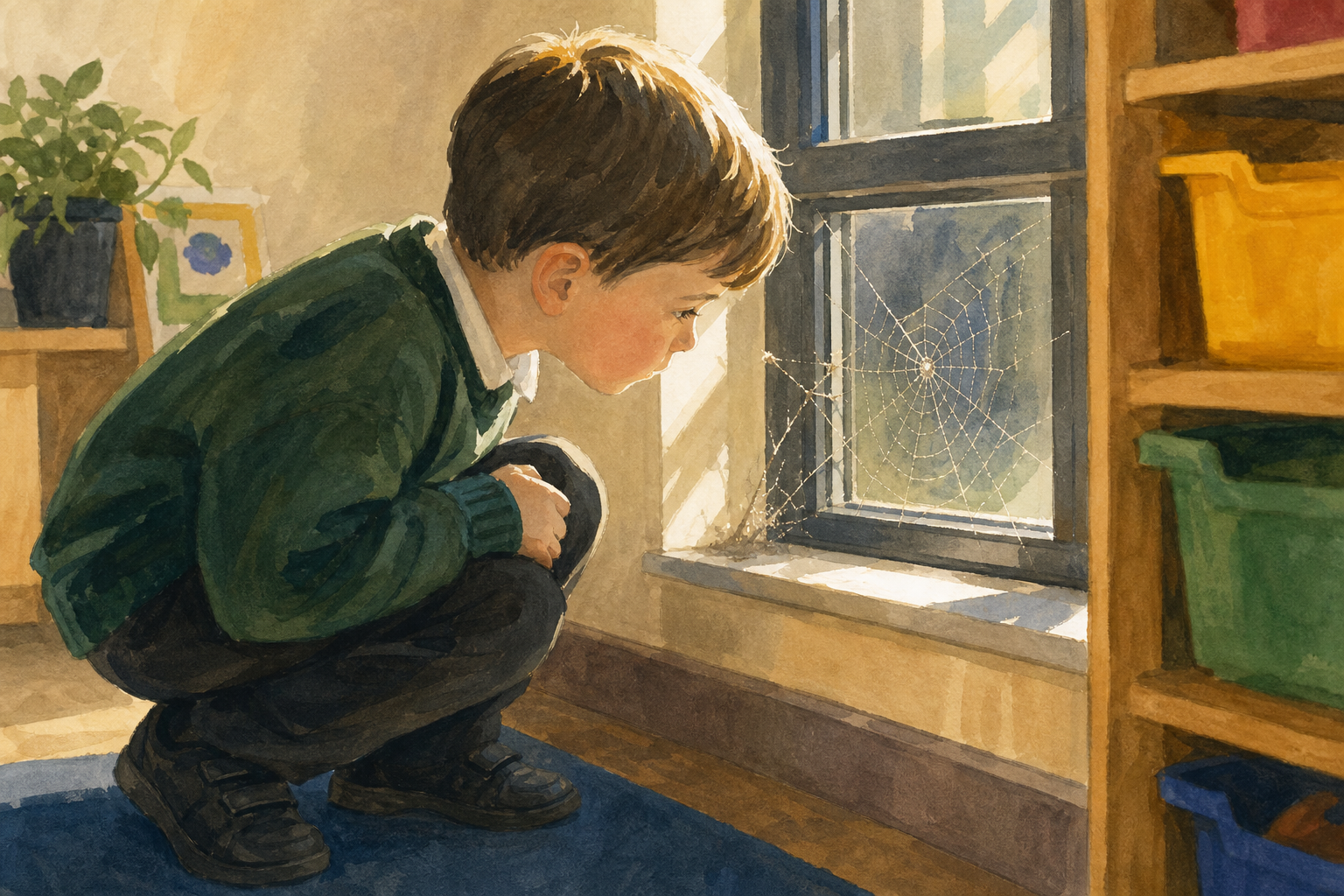
Let's stop very still and quiet for a moment. Look all around our room. What is one thing you can see right now? Maybe a shiny thing, a tiny crack in the wall, or a cobweb in the corner. When we stop and look closely, we are wondering. Today we are all going to be wonderers, just like real scientists!
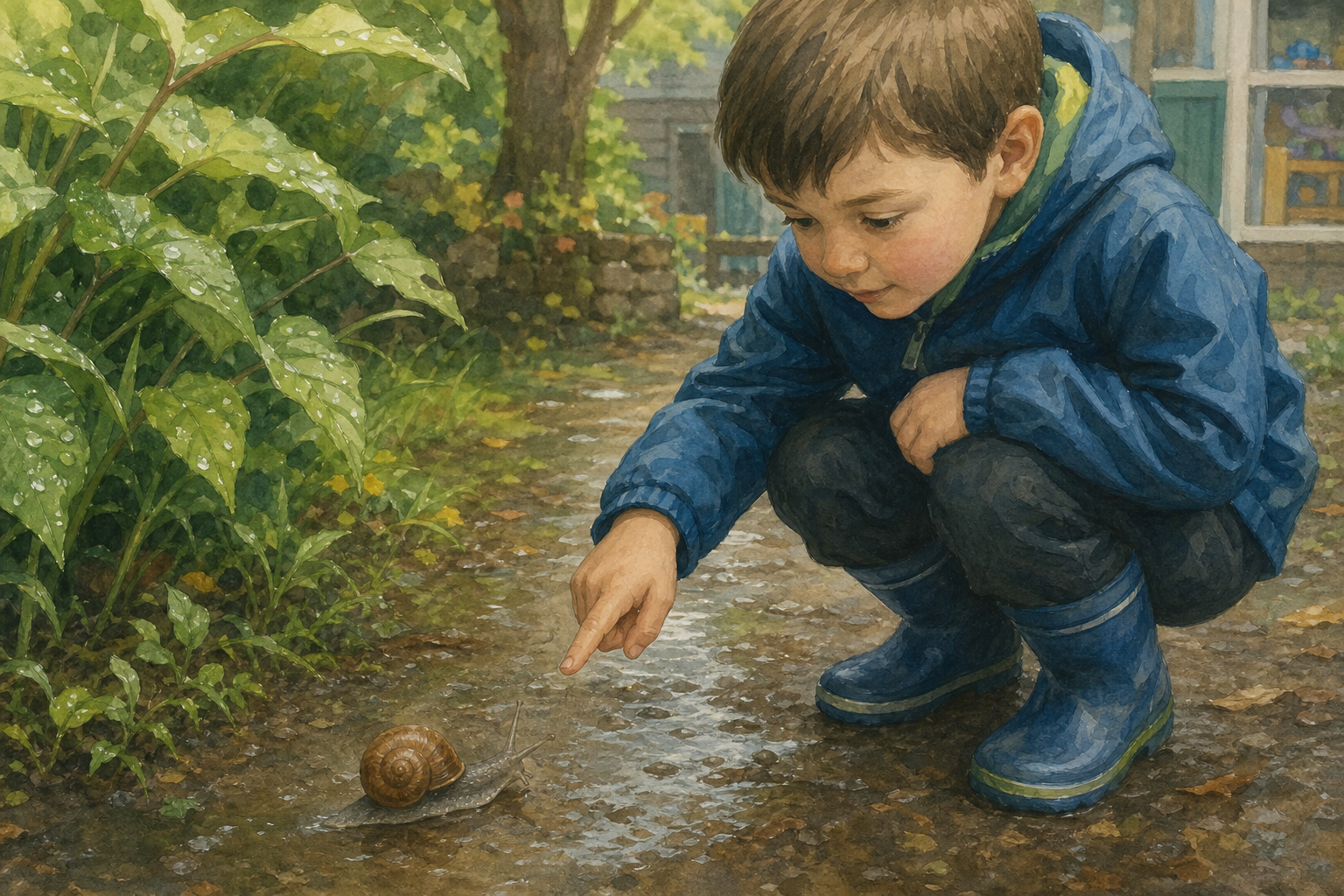
Keep this light and short. Sit the class in a circle and model stopping still yourself, then say 'Ooh, I notice…' about one small thing you can see. This out-loud modelling is the key to the whole lesson: a 4-year-old has no anchor for the word 'wondering' until they see you do it, so make it lively and clear. Invite two or three children to point and say what they notice. Do not set up the walk yet, that comes next.
A wonderer stops, looks closely and says 'I notice…'. Scientists do this every single day! They stop and wonder about the world, then look closely to find out more.
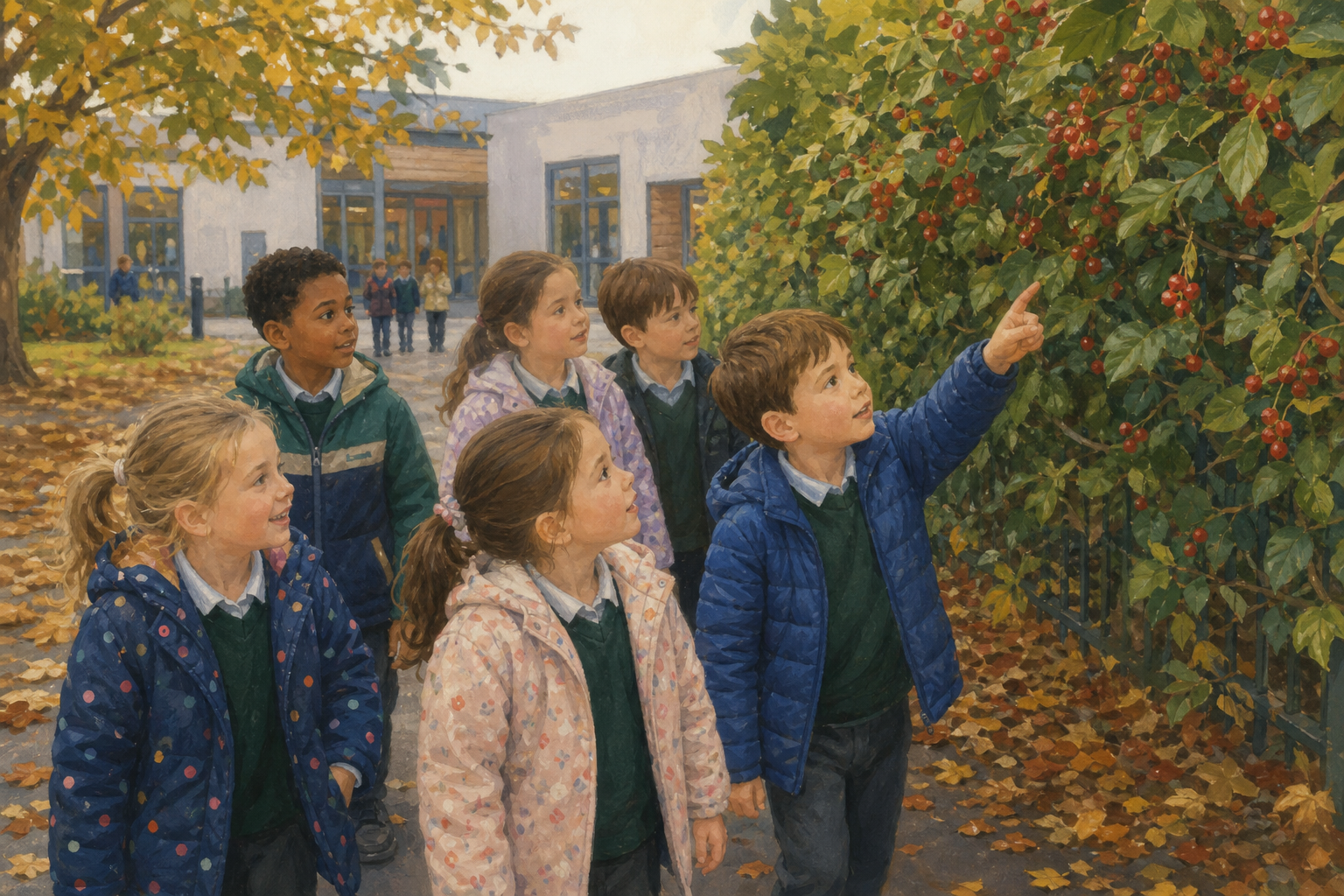
When we go on our wonder walk, we will stop, point, and say 'I notice…' together.
This table is teacher-facing for Junior Infants. Read each idea aloud and use the Example as your own little demonstration script, pointing at real things as you talk.
| Concept | Why it matters | Example |
|---|---|---|
| Wondering — stopping to look closely at something and saying what we notice | Wondering is how we start to find out about everything around us | Stopping by the window to notice a busy spider mending its web |
| Scientist — a person who stops, looks and wonders to find out about the world | It shows children that they can be scientists too, right now | A vet wonders why a puppy is poorly, then looks closely to find out |
Model the wondering out loud first. Say: 'I am going to wonder. I stop. I look closely. I notice the leaves are wet and shiny. I think it must have rained!' Then the children copy this 'stop, look, notice' pattern on the walk.
Now we go on our wonder walk! We will walk slowly around our room and, if we can, out to the yard. When the teacher stops, we all stop and look closely. Then we point and say together: 'I notice…'
Look high and low. Notice the colours, the shapes, the tiny things and the big things. There are no wrong answers, every noticing is a good noticing!
Before the lesson: gather drawing paper and crayons ready for the next step. Plan a short walk route: a loop of the classroom and out to a safe spot in the yard.
Outdoor part is optional and weather-dependent. Coats and transitions in and out are slow for Junior Infants, so if the weather is poor, the yard is unusable, or transitions run long, simply stay indoors: extend the classroom loop to stop at 5 or 6 spots (the window, a plant, the book corner, under a table, near the sink) and keep the exact same 'stop, look, notice' structure. The lesson runs in full either way.
Stop at deliberate spots and prompt: 'Stop! Look closely. What do you notice?' Accept every offering warmly. Safety: stay together as a class outdoors; do not pick or taste anything; wash hands after coming back in.
Weave the 'who helps us?' thread: 'Scientists are people who stop and wonder, just like us!'
Think of one thing you noticed on our wonder walk. It might be a spider, a shiny puddle, a busy ant or a pretty leaf.
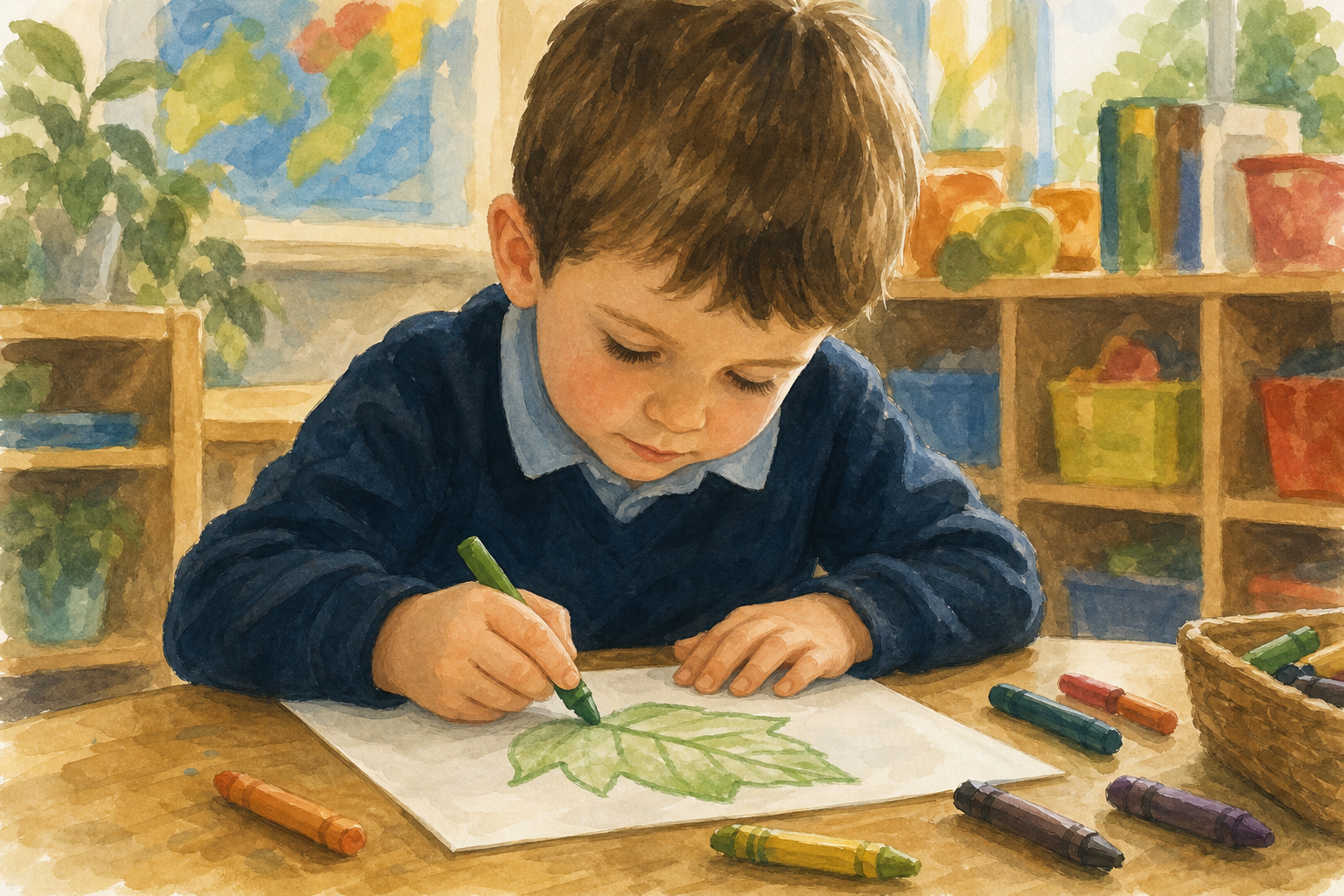
Draw that one thing on your paper. When you are finished, we will pin all our drawings to our class wonder wall so everyone can see what we noticed.
Hand out drawing paper and crayons. Before any child starts drawing, go round and ask each one quietly: 'What is the one thing you noticed?' Many 4-year-olds will freeze if left to pick from a whole walk's worth of noticings on their own, so this quick one-to-one steer is essential, not optional: it gives every child a chosen thing in mind before they put crayon to paper. If a child is stuck, offer them a simple choice of three things the class noticed together and let them point to one. The drawing IS their recording, no writing needed.
The class wonder wall is just a space on an existing wall or noticeboard, or the back of a display board, no special sheet to prepare. Pin the children's own drawings up there together; that pinned collection is the wonder wall. Praise the variety: 'Look how many different things we wondered about!'
Let's sit in our circle and look at our wonder wall together. Who would like to point to their drawing and tell us: 'I noticed…'?
Listen carefully to each other. We wondered about so many different things today, just like real scientists do!
This is a display-only, oral sharing beat, no writing or typing. Gather at the wonder wall. Invite several children to point and say 'I noticed…'. Revoice and celebrate: 'Síle noticed a busy ant, and Tomás noticed a shiny puddle!'
Close the 'who helps us?' thread: 'Scientists are people who stop and wonder. Today we were all wonderers!'
Today we were all wonderers! Here is what we did together:
Keep this very brief and warm. Read the recap aloud, pointing back at the wonder wall. A tiny oral home task: 'Tonight, stop and notice one thing at home and tell someone what you wondered about.'
You're previewing this lesson. Get full access to this lesson and hundreds more — each one ready to teach, with interactive activities, printable resources and pupil progress tracking built in.