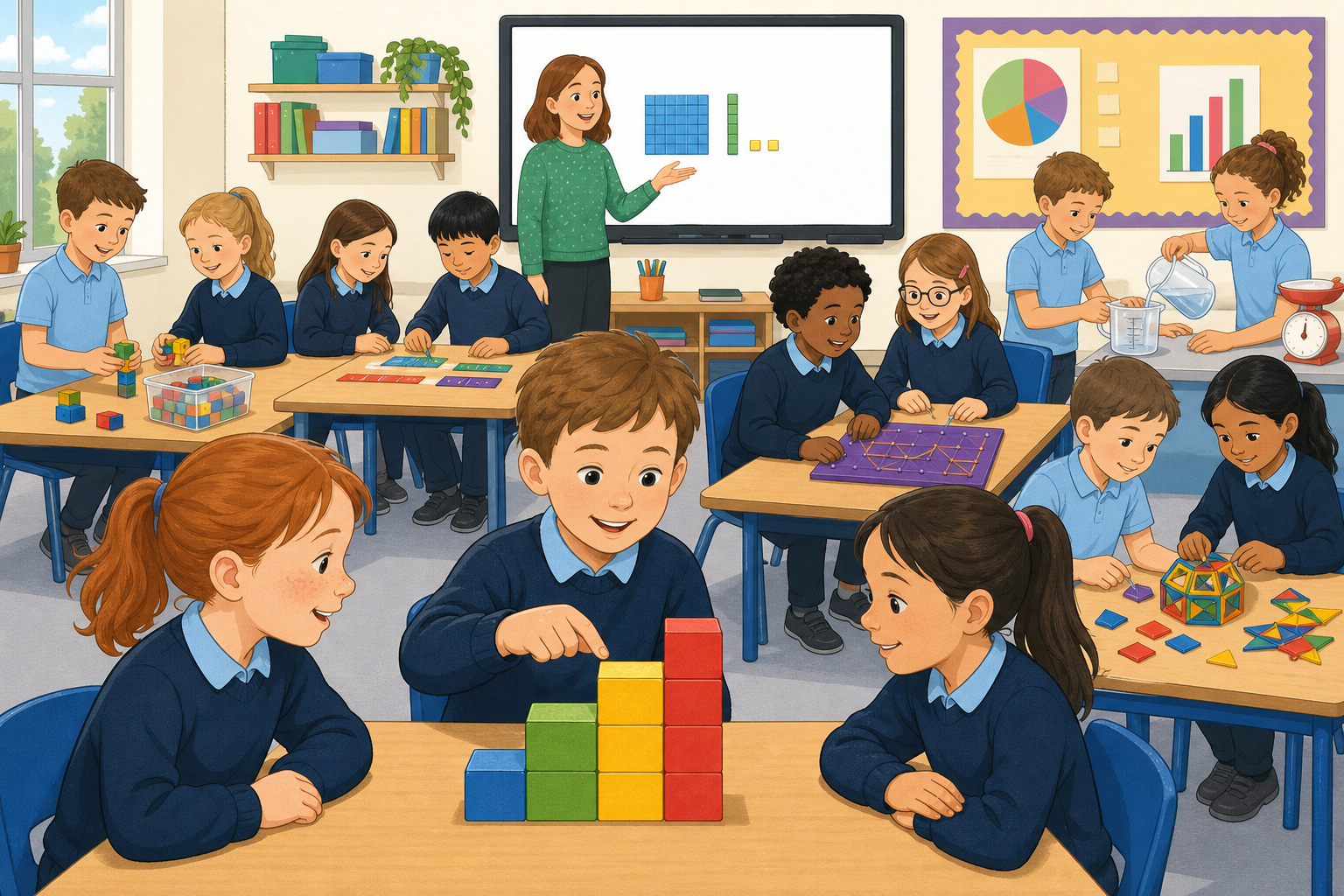
Here is a block staircase. The first step has 1 block. The next step has 3 blocks. The step after that has 5 blocks.
How many blocks do you think the next step will need? Have a guess before we work it out together.
Build the staircase live with pattern blocks (or sketch it) as pupils settle: a column of 1, then 3, then 5. Take three or four genuine guesses for the 4th step before revealing anything — this is a real first attempt, not a teaser. Do not say the rule yet. Let pupils notice the climb of 2 themselves in the next beat.
Each number we land on in a pattern is called a term. The jump between one term and the next is called the step. Let's see what the step does in each pattern below.
Look at the gaps on the number line. Each jump is +2, then +2, then +2. The step stays the same every time.
Now look here. The jumps are +2, then +3, then +4. The step is getting bigger each time, so the step is growing.
Before we keep going: in 1, 3, 6, 10, which is the term and which is the step? Hands up.
This one goes the other way. We take away 4 each time, so the numbers get smaller. The step is shrinking the pattern.
And here, the jumps are +1, then +2, then +4. Each term is double the one before, so the step grows really fast and the numbers pull right apart.
Examine each pattern with the class. Point at the gap between each pair of markers and ask what pupils notice before confirming the labelled jumps.
Name it together, drawn from what they saw: a step can stay the same, grow or shrink.
In your maths copy, draw the next two steps of the block staircase from the start of the lesson. It went 1, 3, 5, 7 blocks. Beside each new step, write how many blocks it adds on from the step before.
This is the same staircase the class built at the start (1, 3, 5, 7). Walk the room glancing at whether pupils have continued with the +2 step (the next two are 9 and 11). This is whole-class copybook practice, not marking — no individual corrections, just a quick scan for the climb of 2.
Now let's test what we found. One pupil comes to the board and marks where the next term lands, then says where the one after would go. Everyone else watches and says the step rule aloud: is the step staying the same, growing or shrinking?
This round is for talking it through together — one pupil works at the board while the watching class says the step rule aloud.
Use this beat to test the rule the class just named: does "the step stays the same / grows / shrinks" still hold? Mark three terms, ask the pupil at the board to place the fourth, then predict the fifth aloud.
The line is loaded with 3, 6, 9 (the step stays the same). Revoice a strong answer: so because the jump stayed the same, you could land the next one without counting all the way.
Today we work through these predictions together. For each pattern, place the marker where the next term belongs, then check it.
The later ones ask you to look further ahead, so use the rule rather than counting one tiny step at a time. The last one doubles each time, so the rule is double the last number: 8 doubles to make 16.
This round is the practice bank — pupils take turns at the board, check each answer, and the class confirms before moving on. Keep the board work brisk rather than over-explaining.
The challenges climb: a constant grow, then a constant shrink, then a longer look-ahead on a constant step, then a doubling pattern where the step grows. For the doubling one, draw out that you cannot count up in equal jumps — you have to apply the rule "double the last number", which the board states on screen and you modelled in the watch beat.
You're previewing this lesson. Get full access to this lesson and hundreds more — each one ready to teach, with interactive activities, printable resources and pupil progress tracking built in.