Mathematics
Intermediate
50 mins
Teacher/Student led
+80 XP
What you need:
IWB/Projector/Large Screen

Frequency Tables and Grouped Data

Learn to organise raw data into frequency tables using tally marks, then group values into equal class intervals. Explore what is gained and lost when data is grouped.
Teacher Class Feed

Load previous activity

    1 - Getting Started ~4 mins

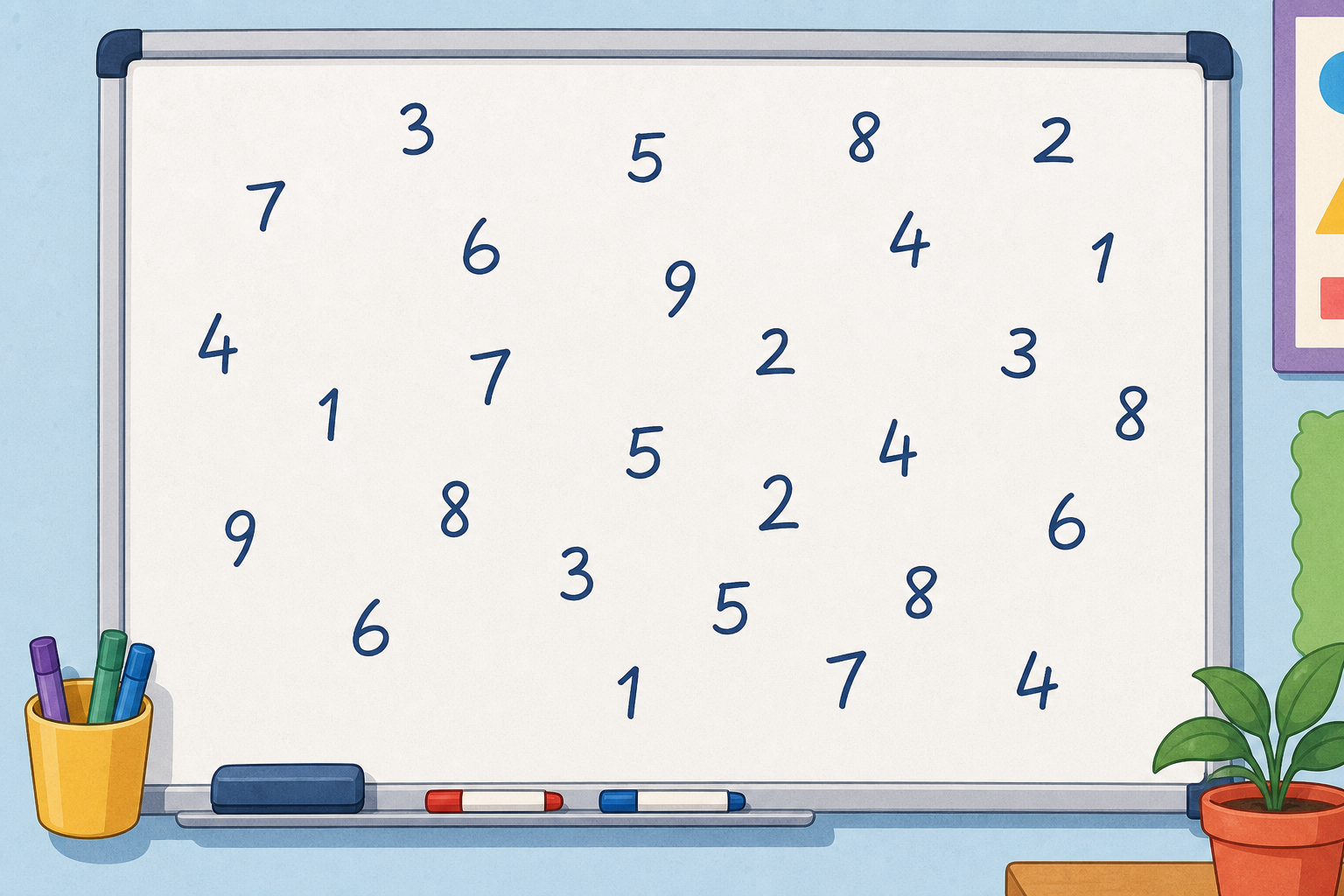
    Illustration for Getting StartedHere is a messy list of reaction-time scores, just numbers scattered across the board with no order at all: 7, 5, 8, 6, 7, 9, 6, 8, 7, 5, 9, 6, 7, 8, 6, 7, 5, 8, 7, 9, 6, 7, 8, 6. Take a good look at them.

    Think about it

    If you had to tell someone what these scores were like, what would you say? How could we tidy this mess into something we can actually make sense of?

    2 - Watch and Notice ~9 mins

    Illustration for Watch and Notice

    Tallying the reaction-time scores: 5, 6, 7, 8, 9

    Watch how we tally the messy scores from a moment ago into a frequency table. Each column header is one of the actual score values, and every time that score appears we add one stroke. Every fifth stroke crosses the previous four so we can read the totals at a glance.

    Grouping ages: 09, 1019, 2029

    When the values spread out too far to list one at a time, we group them into equal bands instead. Notice how each band is the same width (ten years each) and every age has exactly one home. If the bands were too narrow we would end up with dozens of them; too wide and everything would land in one band. We want a number of bands that is useful to read.

    The gap trap: when bands overlap

    Look carefully at these bands: 010 and 1020. The number 10 belongs to both bands, so it has two homes at once. That is the trap. Bands must leave no gaps and never share a number, which is why we write 09 and 1019 instead, so each value fits in exactly one group.

    3 - Try It Together ~7 mins

    Today we explore: here is a fresh set of class data — 18 scores to tally into three equal bands: 4, 11, 20, 7, 15, 22, 9, 13, 25, 6, 18, 21, 8, 14, 27, 12, 19, 24. We will agree on the band edges first, then tally each value into its band and check the totals add back to 18.

    Key point

    Remember the non-overlapping rule: each value has exactly one home. So does 20 go in 1019 or 2029? It goes in 2029, because 1019 stops at 19.

    Tally these 18 scores into three equal bands

    4 - Build the Table in Your Copy ~3 mins

    COPYBOOK MOMENT

    Illustration for Build the Table in Your CopyIn your maths copy, draw a grouped frequency table with three equal class intervals for the data we have been working with. Give it a tally column and a frequency column.

    Fill in the tallies and the frequency for each band, then write the total at the bottom to check it matches the whole set.

    5 - Class Challenge ~12 mins

    Today we work through three different data sets, and we have to choose the right band width for each one. Here are the sets on the board:

    • Set A: 2, 5, 8, 3, 7, 9, 4, 6, 1, 8, 5, 3 (values run 1 to 9)
    • Set B: 12, 27, 35, 8, 19, 41, 23, 16, 38, 29, 5, 44 (values run 5 to 44)
    • Set C: 65, 23, 91, 48, 12, 77, 34, 88, 56, 19, 102, 71 (values run 12 to 102)
    The rule today

    If we choose bands that are too narrow we end up with dozens of nearly empty bands; too wide and everything lands in one. Aim for a band width that gives roughly four to six bands — enough to see the shape of the data without drowning in columns. We will decide the right interval for each set together.

    Choose a band width for each set

    6 - What Did We Notice? ~3 mins

    MATHS TALK

    What do we lose when we group data into bands, and what do we gain? If someone only sees your grouped table, what can they no longer tell about the original scores?

    7 - What's Next ~2 mins

    Today's key ideas

    • A frequency table records how often each value or band appears, with tally marks grouped in fives for easy reading.
    • When values spread too widely, we group them into equal, non-overlapping class intervals.
    • Grouping makes data readable but hides the exact individual values, so the band width matters — aim for a width that gives roughly four to six bands.

    Coming up

    Coming up

    Next we turn frequency tables into charts, building and reading bar charts and multiple bar charts to compare two groups side by side.

    Pupil practice
    Module 9 · Data and Chance Mixed
    Lesson 93 · Frequency Tables and Grouped Data
    Download Activity Book page (PDF)
    End of lesson
    123learn · Online learning platform

    Unlock the full learning experience

    You're previewing this lesson. Get full access to this lesson and hundreds more — each one ready to teach, with interactive activities, printable resources and pupil progress tracking built in.

    Hundreds of curriculum-aligned lessons
    Interactive activities in every lesson
    Printable resources & progress tracking
    Copyright Notice
    This lesson is copyright of 123Learn.ie 2017 - 2025. Unauthorised use, copying or distribution is not allowed.
    🍪 Our website uses cookies to make your browsing experience better. By using our website you agree to our use of cookies. Learn more
