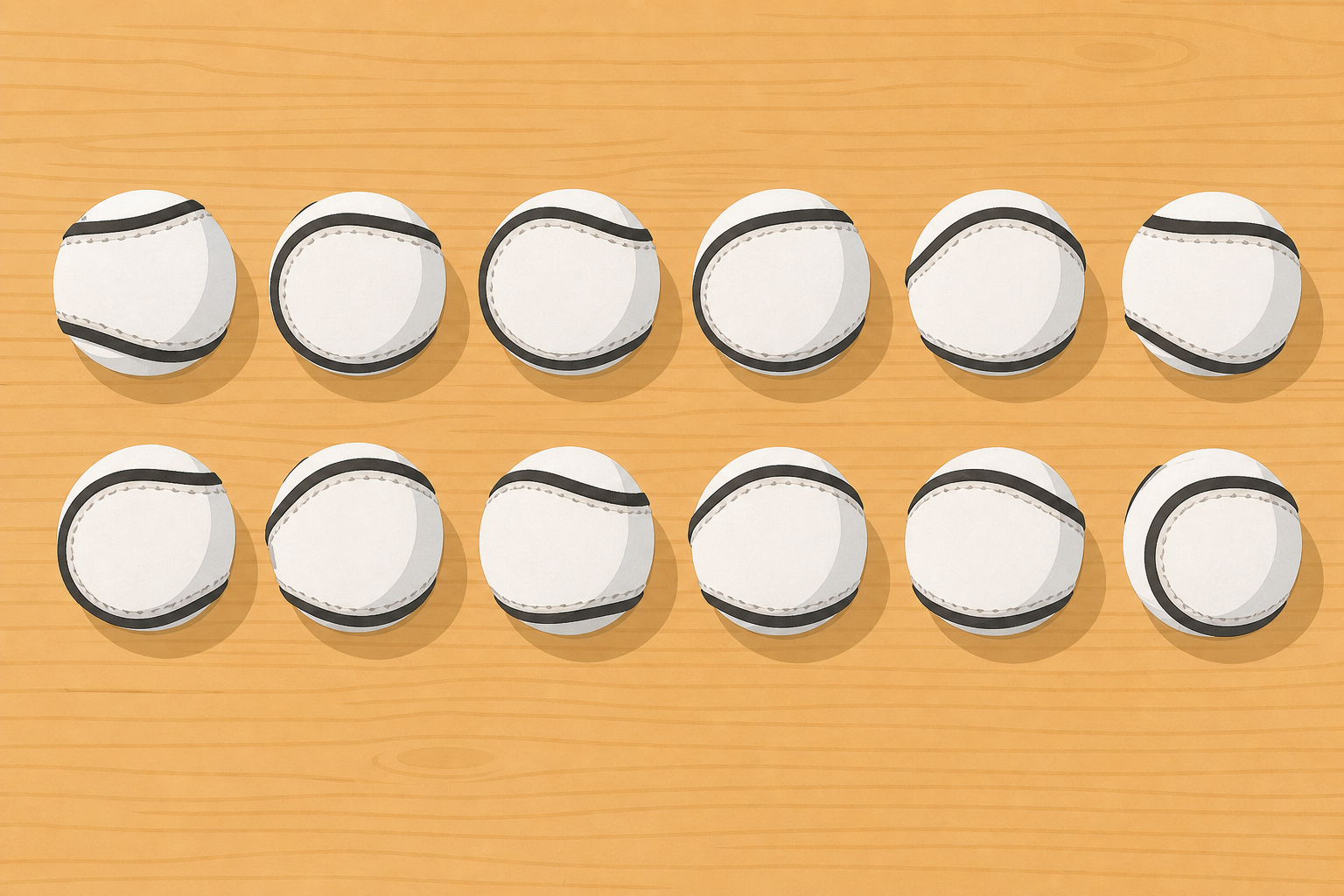
Picture twelve hurling sliotars laid out on the table in front of two GAA teams. One team needs to take their fair share. If we give one half to one team and one half to the other team, how many sliotars does each team get? Have a think before any hands go up.
Give five seconds of quiet think-time before any hands go up, then take two or three answers. Don't reveal the method yet — just let pupils share their first instinct (some will say 6, some will count). The point is to wake up the idea that fair sharing is what fractions of a set are about.
Watch the fraction strips on the board. First we split a whole strip into two equal parts and shade one half. Then we split a strip into four equal parts and shade one quarter. Then a strip into three equal parts for one third. Notice the rule: split the whole into equal parts first, then take the parts you need. The very same rule works when we share a set of counters into equal groups.
Walk each strip aloud, one at a time. Point to the split lines before you point to the shading: first we cut into equal parts, then we shade.
Do not move on until the class can say the rule back to you: split into equal parts, then take the parts you want.
Look at the four strips on the board. One classmate at a time comes up to shade a fraction, and the rest of us follow on the board and agree or correct out loud. We shade one half on the first strip, one quarter on the second, one third on the third, then two quarters on the last strip. Each time, count the equal parts carefully before shading, and check the parts are exactly the same size.
This round is for talking it through together — one pupil shades at the board and the class agrees or corrects out loud. Watching the board is how the rest of the class takes part.
The board shows four strips already split into the right number of equal parts: halves, quarters, thirds, then quarters again. Send one pupil up to shade each one in turn — one half, then one quarter, then one third, then two quarters. Ask the class: are the parts equal? how do you know? Revoice a strong answer: so the more parts we cut, the smaller each part gets. On the last strip, draw out that two quarters reaches exactly the same far edge as one half. Watch for the common slip of treating the shading as random rather than counting from the left — that is the misconception to head off.
In your maths copy, draw 8 dots in a row and ring one half of them. Then, underneath, draw 6 dots and ring one third of them. Count how many you ringed each time and write the number beside your rings.
Walk the room glancing at how pupils are ringing — look for equal groups, not just any 4 dots circled at random. This is whole-class copybook practice, not marking. Prompt anyone stuck with share them into equal groups first.
You each have counters and a 12 cm paper strip at your own desk. We work through these four together, one at a time.
Each time, share into equal parts first, then count.
This round is the practice bank — one pupil leads each task at the board while every pupil works the same task with their own counters and strip at their desk. The class confirms each answer before moving on. Keep the board work brisk rather than over-explaining.
Circulate and catch the slip of unequal groups on the spot. The class reads each result aloud and you reconcile any disagreement.
When we took one half of a length and one half of a set, what was the same about what we did each time?
Listen for pupils naming the shared first step — split or share into equal parts before counting. Revoice a strong answer: so whether it is a strip or a pile of counters, we always make equal parts first, then take the ones we want. Head off anyone who thinks the strip and the counters are different jobs — point back to the equal-parts idea both share.
Both jobs start the same way: make equal parts first, then count.
Next we place fractions on a number line, finding exactly where one half, one quarter and one third sit between 0 and 1.
Keep this brisk. Recap the one big idea — equal parts first — and bridge to the number line by reminding pupils that a fraction can also be a point on a line.
You're previewing this lesson. Get full access to this lesson and hundreds more — each one ready to teach, with interactive activities, printable resources and pupil progress tracking built in.