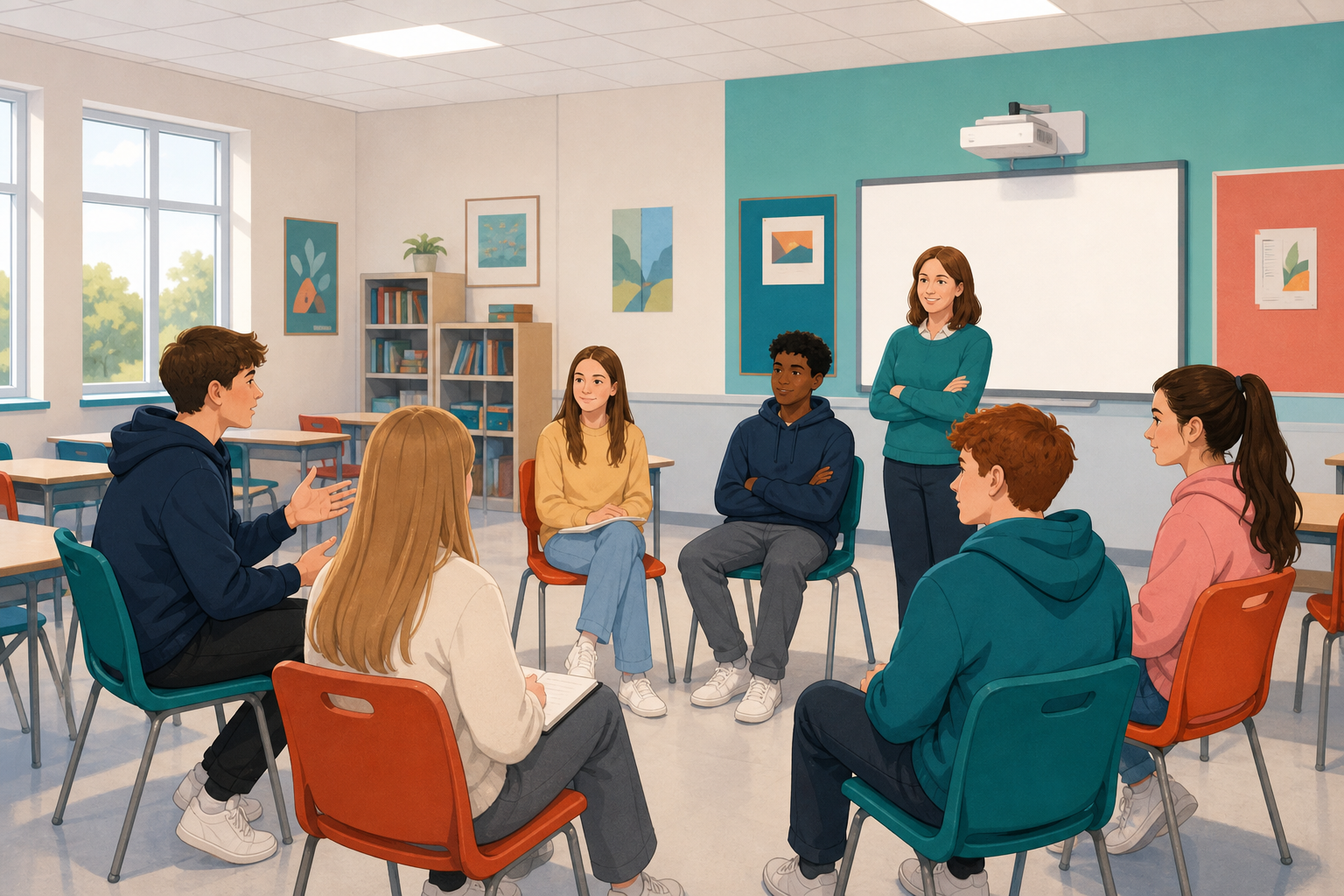
 Digital technologies, such as phones, apps and the internet, are part of almost every day. Today the class will debate a hard question about one of them: social media.
Does social media do more good than harm for people your age?
- Hear the strongest arguments for both sides.
- Argue for one side, which may not be the side you agree with.
- Think again about where you stand and whether anything changed your mind.
 The motion is the sentence that a debate argues about. Today's motion is below.
Social media does more good than harm for people our age.
What steelmanning means
Today you will steelman a side. That means giving the strongest, fairest version of its argument, even if you disagree with it.
For example: "Even if I think social media wastes time, the strongest argument for the other side is that it keeps friendships going when people cannot meet."
Where do you stand?
Before you hear any arguments, decide honestly whether you agree, disagree or are not sure, because you will show this on a line in the next step.
The class will make a line across the room, and your teacher will show the same line on the board.
- Your teacher reads the motion out once more: Social media does more good than harm for people our age.
- Decide where you stand right now and go to that part of the room, with agree at one end, disagree at the other and not sure in the middle. Keep your reasons to yourself for now.
- Your teacher will move a marker on the board for each group, so look at how the class is spread across the line.
After the debate you will come back to the line and place yourself again.
Where you stand now
The class will split into two sides to debate the motion, which is the debate sentence: Social media does more good than harm for people our age. You may be asked to argue for the side you disagree with.
| Stage | Time | What happens |
|---|---|---|
| 1. Prepare | 5 min | Your side has two speakers, chosen by your teacher: an opener, who gives the opening statement, and a steelmanner, who puts the other side's case. Together, pick your two strongest points from your list below, or use a point of your own that is not on the list. Finish this sentence for each one, using the example or one of your own: Our strongest point is… because… |
| 2. Opening statements | 2 min each | The For side's opener speaks first, then the Against side's opener. Nobody interrupts. |
| 3. Steelman | 90 seconds each | Each side's steelmanner explains the other side's argument so fairly that the other side would agree with how it was put. |
| 4. Open floor | About 20 seconds each | Anyone can make a short comment, up to four comments for the whole class. |
Challenge ideas, not people. Use made-up names only, and never target anyone in the room.
Use only your own side's list, or a point of your own. Here are both lists, so you can see what the other side has.
| For the motion | Against the motion |
|---|---|
| Connection: keeps friendships going when people cannot meet, and helps new students find their group. For example, a student who moves school keeps in touch with old friends in a group chat. | Comparison and pressure: highlight reels, which show only the best moments of people's lives, push people to compare themselves with edited versions of others. For example, someone scrolls through friends' holiday photos and feels their own summer was boring. |
| Learning and interests: tutorials, hobby communities, language practice and exam tips that are hard to find offline. For example, someone teaching themselves guitar follows a free video lesson every evening. | Privacy and permanence: posts, screenshots and location data last long after the moment and can be used in ways the poster never meant. For example, a joke photo in a group chat is screenshotted and passed around the school a year later. |
| Voice and creativity: people your age can make things and be heard without waiting for an adult to let them. For example, a student posts a short film they made and gets comments from people they have never met. | False or twisted claims: rumours travel faster than corrections, and angry content spreads especially well. For example, a rumour that school is closed spreads in minutes, and the correction reaches far fewer people. |
| Support and information: reliable advice, and people who have been through the same thing, can be found quickly when something is hard. For example, someone nervous about a hospital visit reads how other young people got through it. | Time, sleep and attention: feeds are designed to hold you, crowding out rest, schoolwork and face-to-face time. For example, someone means to watch one video at bedtime and is still scrolling an hour later. |
| Belonging: fans of the same music, sport or cause can find people like them online, even when there is nothing like it nearby. For example, the only fan of a sport in a small town finds a whole club of fans online. | Hurt and being left out: pile-ons, where lots of people gang up on one person, being left out of group chats, and mean comments all hurt and are hard to switch off. For example, a student sees photos in a group chat of a party they were not invited to. |
Unlock the full learning experience
You're previewing this lesson. Get full access to this lesson and hundreds more — each one ready to teach, with interactive activities, printable resources and pupil progress tracking built in.
This lesson is copyright of 123Learn.ie 2017 - 2026. Unauthorised use, copying or distribution is not allowed.