A robin pulls a worm from the school lawn. A fox trots across a field at dusk. What is the link between the grass growing in our school garden and that hungry fox? Every meal can be traced back, link by link, to one place. Where do you think all the energy in our wildlife really begins? Hands up your guess.
Keep this light, it is just the curiosity beat. Take a few guesses and write none of them off. Draw out 'the sun' if a pupil says it, but don't resolve the question yet, that comes next.
All the energy in a habitat starts with the sun. Plants catch sunlight and use it to grow, so they make their own food. We call plants producers. Animals cannot catch sunlight, so they must eat to get their energy. An arrow in a food chain always points from the food to the eater, because that is the direction the energy travels.
| Concept | Why it matters | Example |
|---|---|---|
| Producer — a plant that makes its own food using energy from the sun | The start of every food chain | Grass, oak leaves and bramble in an Irish hedgerow |
| Consumer — an animal that gets its energy by eating other living things | Cannot make its own food | A rabbit eats grass; a fox eats the rabbit |
| Concept | Why it matters | Example |
|---|---|---|
| Food web — several food chains joined together because most animals eat more than one food | Real habitats are webs, not single lines | A fox eats rabbits and mice; an owl eats mice too |
This is the pupil-facing teaching content. To keep the load light, reveal it in two beats rather than all at once: first read and point through the producer/consumer table and let those two ideas settle (ask the questions below), then bring up the food web row underneath only when the first two are clear. Three new terms in one screen is a lot, so pace it.
The on-screen 'Why it matters' cells are deliberately short so the screen is not dense; say the fuller reasoning aloud: producers matter because all the energy that feeds the animals comes through them first, from the sun; consumers matter because they depend on the producers and on the animals below them; and a web matters because removing one link can change many others, not just one chain.
The big idea to land: the arrow points the way the energy travels, from food to eater, not the way the animal moves. A very common mistake is drawing the arrow from the fox to the rabbit because 'the fox goes to find the rabbit'. Head that off now.
Ask after the first table: Why is grass at the start of so many chains? What would happen with no sun? Then move on to the food-web row.
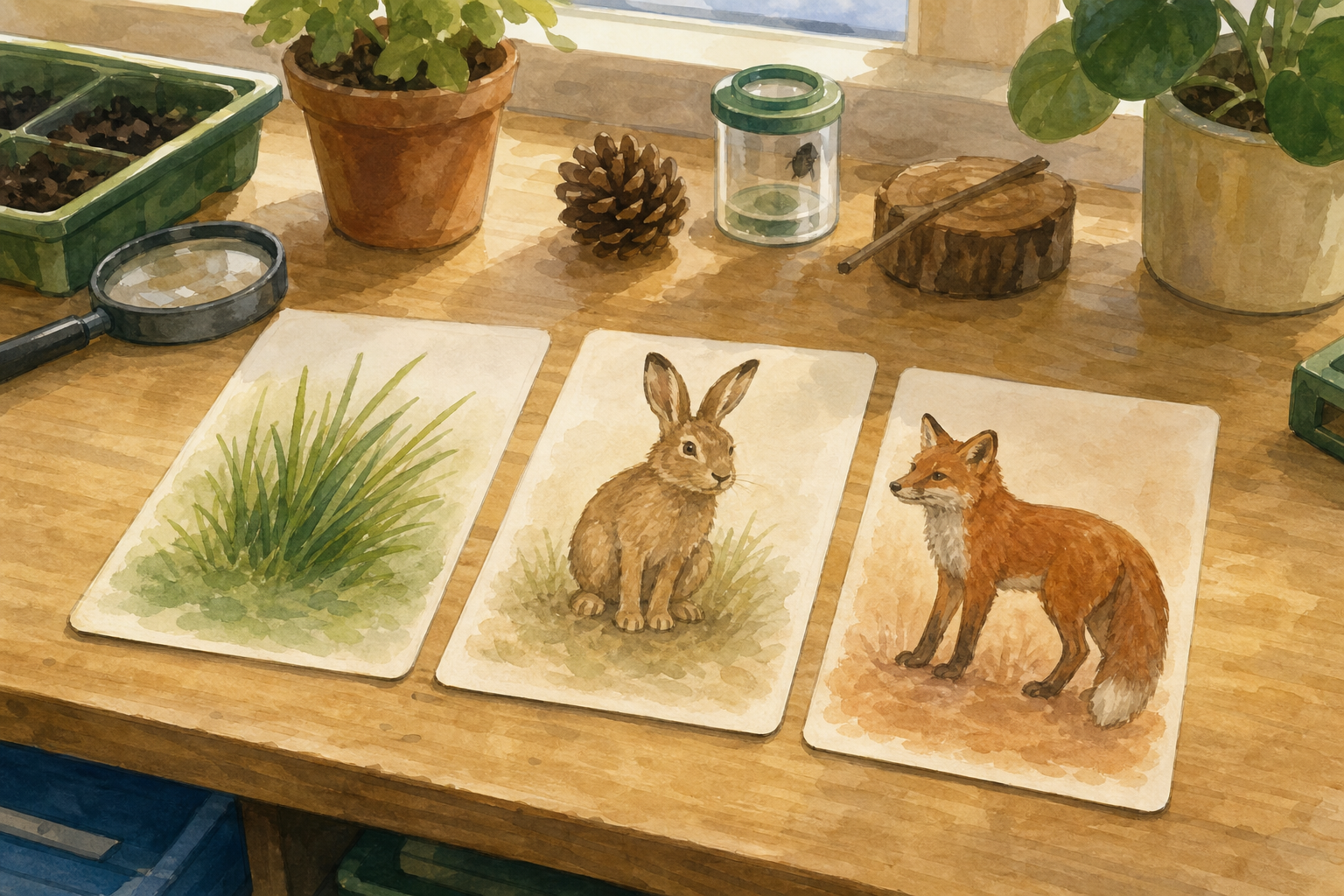
Let's watch one Irish food chain built in order on the screen. Three cards appear: grass, rabbit and fox. Watch where each arrow points and notice that it always points towards the animal doing the eating.
This is the modelled cycle, do it out loud as a full think-aloud before the groups build their own.
Drive the interactive on the IWB. The finished chain shows grass → rabbit → fox, with the arrows reading 'is eaten by'. Say each beat aloud:
The display is static, so talk about what the class sees, do not ask them to drag anything here.
Now it's our turn. Let's build an Irish hedgerow food chain together on the screen. Five cards appear: oak leaf, caterpillar, blue tit, sparrowhawk and one extra, sun. Where does the energy begin? Which card goes next? Remember, the arrow always points from the food towards the eater.
Explore mode, the class calls out the order and you build it live. The correct chain is oak leaf → caterpillar → blue tit → sparrowhawk.
Important — the sun arrow needs your voice. The sun card is a deliberate talking point: the sun powers the chain but is not 'eaten'. The first arrow in the arrowLabels config is set to 'gives energy to' so the screen and your words agree; even so, say it aloud as you place the sun before the oak leaf so the class hears the distinction, NOT just sees it. Tell them this arrow means 'gives energy to', not 'is eaten by'. Write 'gives energy to' on the board beside that arrow if it helps.
Fold the whole class in: Are they right? What would you put next? What does the caterpillar give the blue tit?
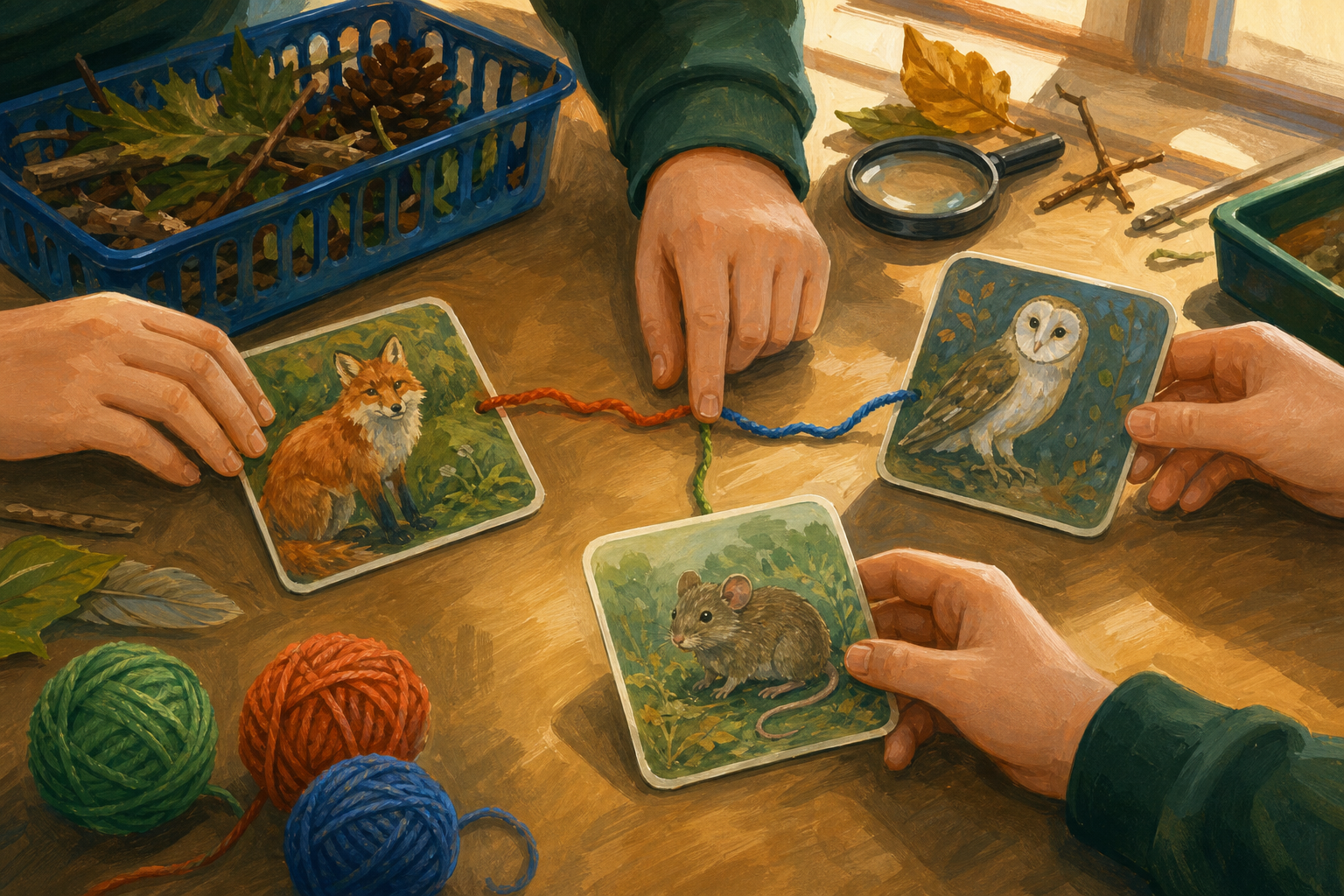
Real habitats are not single lines, because most animals eat more than one thing. In your group you will build a hedgerow web from your arrow cards and string. A link means one arrow joining a food to its eater (for example, grass to rabbit is one link). Here is the order to follow:
Hand each pupil their own Drawing Record page at the start of this step, and hand each group a card set and string. The cards in each set are: grass, bramble, oak leaf, caterpillar, rabbit, mouse, blue tit, hedgehog, fox, owl, plus arrow cards.
Pacing — protect the drawing. Split this 20-minute slot roughly as ~12 minutes building and checking, then ~8 minutes drawing. Call the transition aloud at the 12-minute mark: 'Stop building, even if you have more links to add — now everyone draws what you have.' The per-pupil drawing is the recording that the summary and homework lean on, so it must not be the beat that gets squeezed out. For groups still building when you call time, the five-link minimum is enough to draw; they do not need a 'finished' web. If a group is racing ahead, let them keep adding links on paper as they draw.
Give every group the printed card set. The sketch-your-own-cards substitute is a last resort only — do not use it just to save printing, because time spent drawing cards eats straight into the web-building and the per-pupil web drawing, and those groups will overrun. If you genuinely cannot print full sets for a group, give them the smaller five-card set (grass, rabbit, mouse, fox, owl) or a partial template with the producers already placed, so their build time goes on the web, not on making cards.
There is no single 'right' web, this is the open beat, let groups decide which links to show. Good links to look for: grass and bramble feed the rabbit; the oak leaf feeds the caterpillar; the caterpillar feeds the blue tit; seeds and grass feed the mouse; the fox eats both rabbit and mouse; the owl eats the mouse; the hedgehog eats caterpillars and beetles. The key idea is shared food and shared predators, that is what makes it a web.
Watch for arrows pointing the wrong way, the food-to-eater direction is the thing to keep correcting. Each pupil records their own web on their Drawing Record page.
Differentiation: give a struggling group a smaller card set (grass, rabbit, mouse, fox, owl); challenge a fast group to add the sun and an arrow to the soil where things decay.

Now for the big question: what happens to the whole web if one link disappears? Imagine a hard winter and all the rabbits in your hedgerow are gone. With your group, say your guesses out loud first. There is no single right answer here, so share whatever you think. Then trace the arrows to check. Which animals now have less to eat? Will any animal eat more of something else instead? Could any living thing actually do better?
This is a display-only science-talk beat, run it on the groups' own paper webs.
Call a creature to 'remove' (rabbit, then caterpillar, then mouse). For each removal, ask groups to say their predictions aloud before they trace the arrows, then trace them. Make it explicit that these are spoken guesses and that there is no single right answer, so every idea is welcome. Draw out: the fox now depends more on the mouse; if the mouse is also scarce the fox struggles; the grass the rabbit ate might grow taller. This is interdependence, everything is connected, so one change ripples outward.
Key questions: Which animal is hit hardest, and why? Which animal has a backup food, so copes better? What does this tell us about looking after every part of a habitat, not just the cuddly ones?
Connect to the real world: Irish ecologists study food webs exactly like this when they plan how to protect a habitat, because removing one species, or losing the insects that feed so many birds, affects the whole community.
Energy in every Irish habitat begins with the sun, is caught by plants, and flows along the arrows from food to eater. Real habitats are webs, not single lines, and because living things depend on each other, removing one link sends ripples right across the community. Look back at your web: can you point to the producer, a consumer, and one animal that would be in trouble if its food vanished?
Display-only close. Revoice the strong pupil ideas from the remove-a-link talk. Check the three takeaways: the arrow points from food to eater; the energy starts with the sun; a web is many chains joined, so a change to one link affects others.
Homework (hands-on, recorded in the journal): ask pupils to watch their own garden, street or park for a few days and spot one real feeding link, an animal eating something, and draw that mini food chain to bring back.
You're previewing this lesson. Get full access to this lesson and hundreds more — each one ready to teach, with interactive activities, printable resources and pupil progress tracking built in.