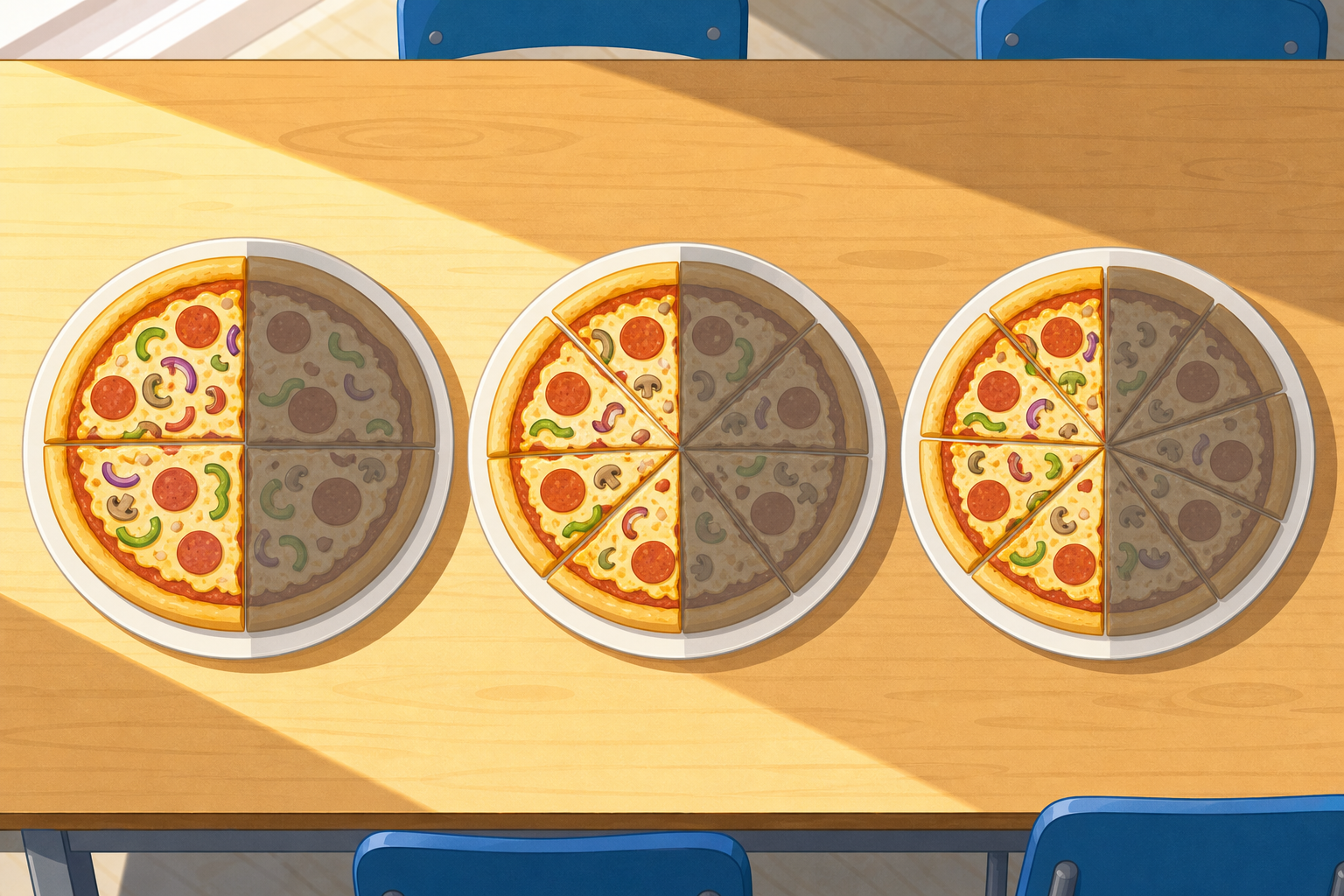
Look at these three slices of pizza: 2/4, 3/6 and 4/8. Each one is part of a whole pizza. Are they actually the same amount of pizza, even though the numbers look so different? And if they are the same, which one is written in the simplest, tidiest way?
Take three hands-up answers, not open call-outs. Let pupils argue both ways for a moment before any reveal.
Listen for the misconception that bigger numbers mean more pizza — head it off by reminding the class that the whole pizza is the same size each time.

Watch the fraction strips. Two parts out of four, three parts out of six and four parts out of eight all reach exactly the same length as one part out of two. So our three pizza slices were the same amount all along, and the tidiest way to write that amount is 1/2. To get there, we divide the top and bottom by the same number until they cannot go any smaller.
Six parts out of nine matches two parts out of three. We got there by dividing both the top and the bottom by 3. A number that divides evenly into both the top and the bottom is called a common factor, so 3 is a common factor of 6 and 9.
Eight parts out of twelve also matches two parts out of three. This time we divide both numbers by 4. Because 4 is the biggest common factor of 8 and 12, dividing by it lands us on the simplest form in one go.
Fifteen parts out of twenty matches three parts out of four once we divide both the top and the bottom by their common factor 5.
Walk each example aloud, one at a time, pointing at where the strips line up.
Today we explore equivalent fractions on the strips. We will build a fraction, then find another strip that reaches the same length. Try 4/8 first, then look for the simplest strip that matches it. Next we will check 9/12 the same way, naming the common factor we divide by each time.
This round is for talking it through together — pupils take turns at the board and the class agrees or corrects out loud.
Invite a pupil to build 4/8, then have a second pupil drag a tidier strip beside it until the lengths match. Ask 'what common factor did you divide the top and bottom by?' each time.
Watch for pupils who only halve once when a fraction could go further — push them to check whether the new fraction can still be divided.
In your maths copy, write each of these fractions and beside it write its simplest form. Between the two, write the number you divided the top and bottom by. Then circle the simplest form.
Walk the room and glance for the dividing number written between each pair — this is whole-class copybook practice, not marking.
Today we work through these together on the strips: simplify 4/6, then 9/12, then 16/24. The last one can be divided more than once, so check whether your answer can go any further. Then a quick oral stretch: in your head, name three different fractions that all equal 3/5, and tell us what you multiplied the top and bottom by each time.
This round is the practice bank — pupils take turns at the board, check each answer, and the class confirms before moving on. Keep the board work brisk rather than over-explaining.
The tricky one is 16/24: a pupil who divides only by 2 lands on 8/12, which still simplifies. Ask 'is that as simple as it goes?' and let the class spot that 8 is the biggest common factor.
The 3/5 stretch is oral, not on the widget — take two or three answers (6/10, 9/15, 12/20) and ask each pupil what they multiplied top and bottom by.
How do you know when a fraction cannot be simplified any further? What do the top and bottom numbers have in common, or not have in common, once you reach the simplest form?
Listen for pupils saying the top and bottom share no common factor other than 1. Revoice a strong answer: 'so once there's no number that divides into both, we've reached the simplest form.' Head off the idea that a fraction is simplest just because it looks small.
Next we will compare and order fractions that have different bottom numbers, using a common denominator to line them up fairly.
Keep this brief — recap the three takeaways and preview the comparing-fractions lesson to come. The activity book page on simplest form gives pupils their paper practice for this lesson.
You're previewing this lesson. Get full access to this lesson and hundreds more — each one ready to teach, with interactive activities, printable resources and pupil progress tracking built in.