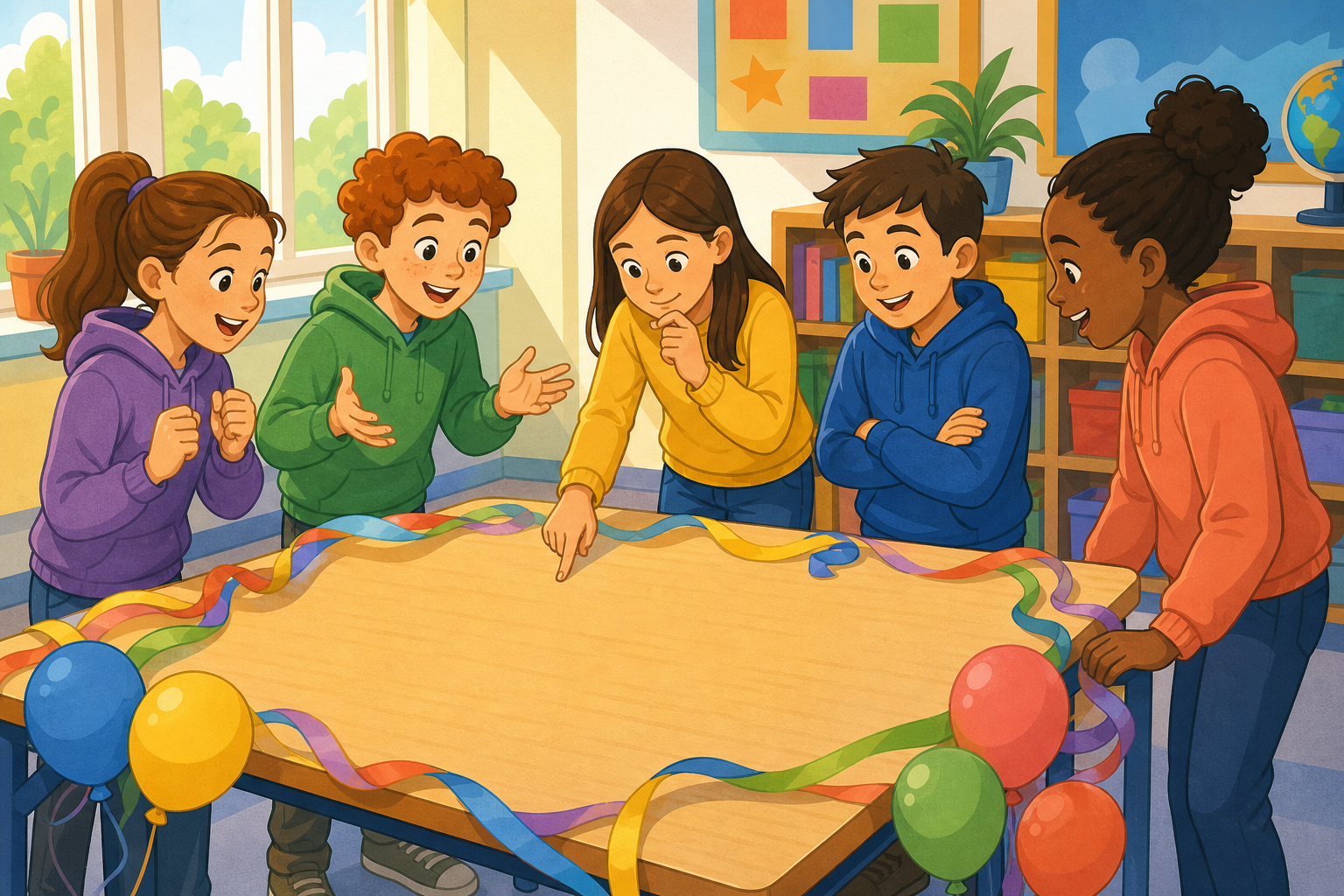
Here is our brief for today: every pupil puts in €8, and there are 28 of us. We are planning a class celebration to mark the end of primary school. Before we can spend a single euro, what is the very first thing we need to decide?
Display the brief (€8 per pupil, 28 pupils) as pupils settle. Take three hands-up answers, not open call-outs. Listen for 'how much money have we got altogether?' — steer toward working out the total cap, 28 × €8 = €224, but leave the calculation for Watch and Notice.
Watch as we set up the celebration budget on screen. We will build it in three steps.
Step one — the cap. First we work out how much we have to spend: 28 pupils × €8 each = €224. That is the most we can spend, our ceiling.
Step two — a bulk discount. The food order is €60, but buying a large amount earns 10% off. 10% of €60 is €6, so the food drops to €54, and that €6 stays in our balance.
Step three — a fair share. The activity costs €56 and 28 of us share it. €56 ÷ 28 = €2 each, so every pupil's fair share of the activity is €2. Notice how the running balance changes after each cost is added.
Point to each pre-built example on the class-budget tray in turn — this is a static snapshot, narrate it, do not drag.
Do not let the class move on until they can say what the green-to-red balance bar means.
Today we plan one celebration together on the board. We will call out categories, enter an amount for each, and keep one eye on the progress bar. Our job is to stay at or under the €224 cap while still feeding everyone and having something fun to do.
This round is for talking it through together — pupils take turns at the board and the class agrees or corrects out loud.
Take a category from the class, send an individual pupil up to enter the amount, and have everyone watch the running balance. When the bar nudges toward the cap, pause and ask 'how much have we left?'. If a suggested amount tips it over €224, ask which other category they would trim. Keep the money in plain euros and cents.
Now copy this worked plan into your maths copy to practise the layout. This is a fresh example to work from, not the plan we just built on the board. Write each category on its own line with its cost and its share-per-pupil beside it. Total the four costs at the bottom, then write how much of the €224 is left.
The first share is done for you so you can see the method — divide each cost by 28 to find the share:
Walk the room glancing at column alignment and the running total — this is whole-class copybook practice, not marking. The four costs total €168, so €224 − €168 = €56 is left; watch for pupils who forget to subtract their total from €224 at the end, or who divide by the number of categories instead of 28. The first share (€56 ÷ 28 = €2) is pre-worked so weaker readers have a model to copy.
Today you design your own celebration plan within the €224 cap. Spread the money across food, drinks, decorations and an activity so nothing is left out and the total stays under the cap.
If you'd like a real challenge, swap one item for a cheaper option and work out how much you saved as a percentage. Here is how to find a saving as a percentage: you take the amount you saved, divide it by the original price, then multiply by 100. For example, if you swap a €40 item for a €30 one, you saved €10. So €10 ÷ €40 = 0.25, and 0.25 × 100 = 25% off.
This round is the practice bank — pupils take turns at the board, check each answer, and the class confirms before moving on. Keep the board work brisk rather than over-explaining.
The bank steps up: first a straight allocation, then one with a bulk discount, then one with a per-pupil share, then the percentage-saving stretch. The percentage method (saving ÷ original × 100) is now demonstrated on screen above, so point back to that worked €10-on-€40 example rather than introducing it cold.
All four costs came out of the same €224 fund, so trimming any one of them by a euro frees exactly that euro. When the budget got tight, which items felt like things we really needed, and which were nice-to-have extras we could cut without spoiling the day?
Steer the talk toward need-versus-nice-to-have, not toward one category being mathematically more powerful — a euro saved anywhere frees a euro. If you want to bring in the per-head idea, make it accurate: 'if each pupil's food share drops by 50c, the whole class saves €14, because 28 pupils each save 50c'. Revoice a strong answer about which items the class agreed they could trim without losing the celebration.
Next we step back through the whole year's maths journal, choose the pieces we are proudest of, and reflect on how our thinking has grown across primary school.
Close by reminding the class that budgeting pulls together money, percentages and division — three strands working together on one real problem.
You're previewing this lesson. Get full access to this lesson and hundreds more — each one ready to teach, with interactive activities, printable resources and pupil progress tracking built in.