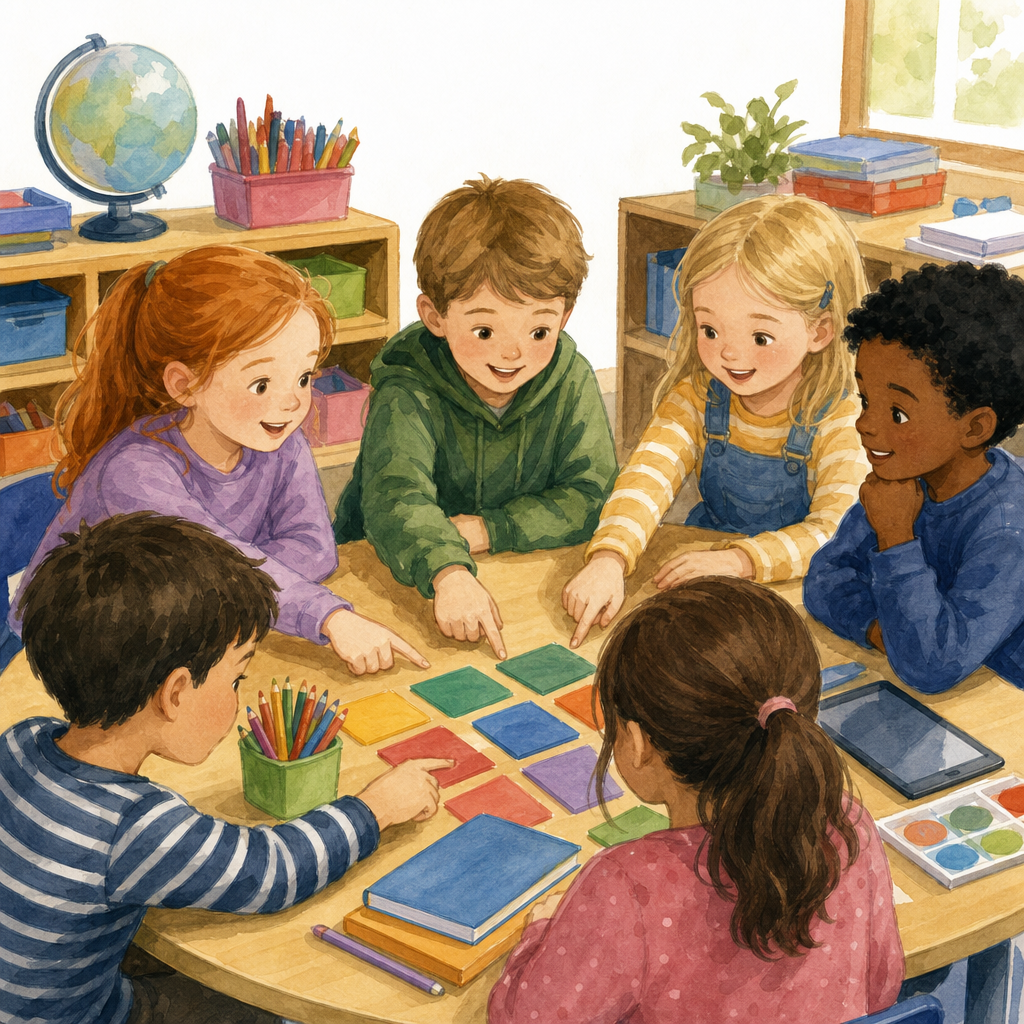
 Look around the room. Name three things you can see and say their colours in English.
Today we put those same colour words into short German descriptions. We will also watch what happens to the ending when the colour sits in front of a noun, the way you might see colours named on a German pencil case or a Schultüte (the big cone of stationery German children get when they start school).
By the end of this lesson, you will be able to:
- Name eight colours in German
- Describe a familiar thing with a colour word in the right form
- Spot when a German colour ending changes before a noun
First pass: listen to the German colour on each card, then say it together with the class.
Second pass: English shows first; try the German before the card flips, then listen to check.
Partway through, you will stop and try three short phrases aloud together. In the second and third, you will hear how the colour sounds different when it comes in front of the thing it describes:
- Der Ball ist rot.
- der rote Ball
- das grüne Buch
Click each German colour, then its English meaning. When a volunteer picks a word, say the German quietly with the class, then listen: a right pair says it again.
Open your copy. The models and word banks below stay on the board while you write. Write two short descriptions by copying the pattern and changing the colour and the thing.
Models:
- der rote Ball (dair ROH-tuh bal)
- das grüne Buch (das GRUE-nuh bookh)
Colour bank: rot/rote · blau/blaue · grün/grüne · gelb/gelbe
Noun bank: der Ball · das Buch · der Stift · die Tür · das Heft
Copy the pattern: article + colour-with--e + noun. If you get stuck on a noun, write the English in brackets. Take the umlaut on grün from the bank on the board — you do not need to invent the spelling from memory.
Unlock the full learning experience
You're previewing this lesson. Get full access to this lesson and hundreds more — each one ready to teach, with interactive activities, printable resources and pupil progress tracking built in.
This lesson is copyright of 123Learn.ie 2017 - 2026. Unauthorised use, copying or distribution is not allowed.