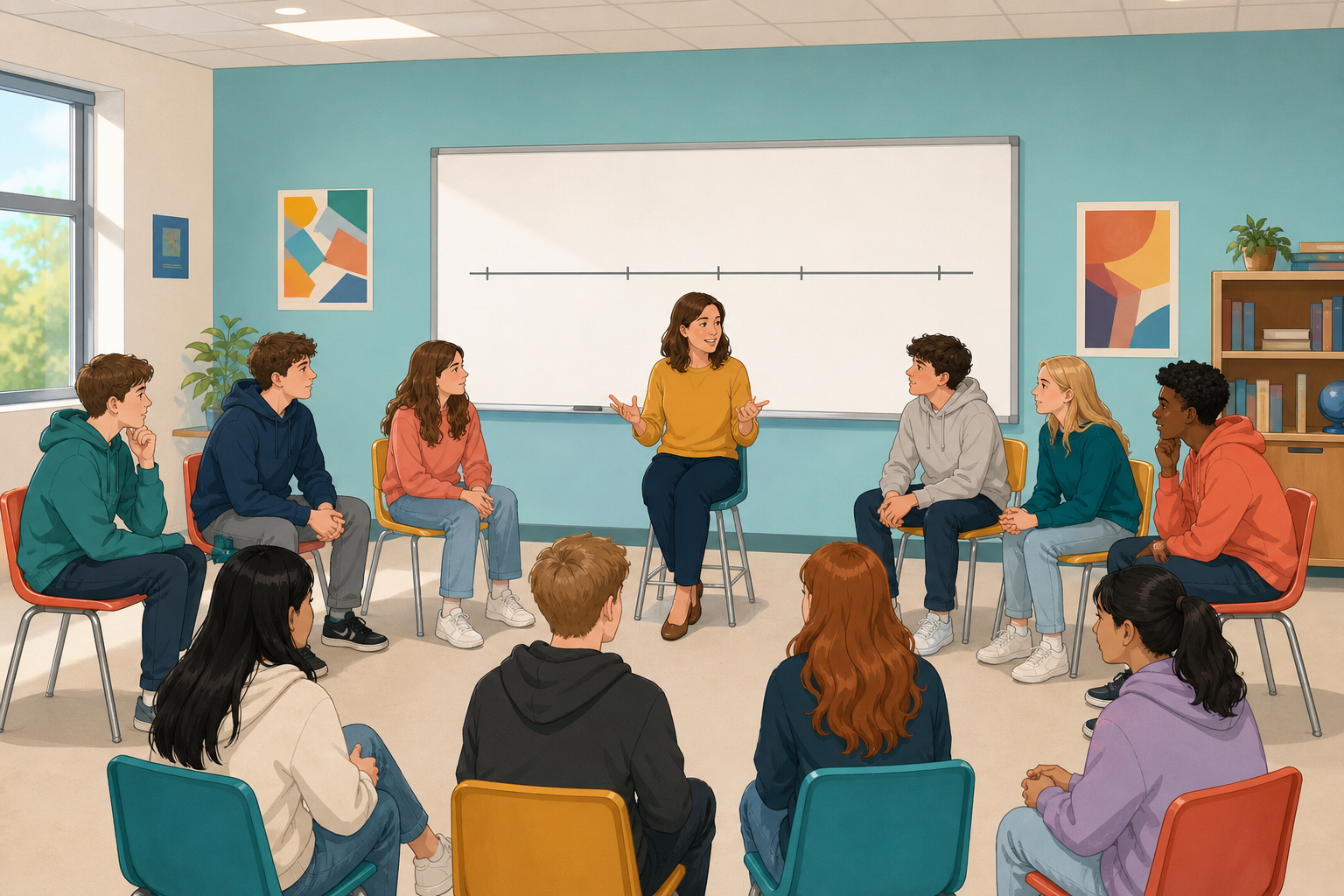
 You have audited AI answers that sounded confident when they were wrong, judged synthetic media and online claims, and trained and tested simple image and pose models. Today you weigh both sides of AI in young people's lives. There is no right answer the lesson is steering you toward. You will take a stand, hear the strongest case for each side, argue, and see whether anyone moves.
 Today's motion:
"The advantages of AI for young people outweigh the disadvantages."
Before any evidence, notice your gut reaction. Agree, disagree, or not sure is all fine. What matters is that you can say why.
Both sides get a fair hearing. On the promise side: creativity (starting points for writing, art and ideas), access (explanations, language support, help when you are stuck), speed (draft help and pattern-spotting that can free time for human judgement), and models that learn a pattern you chose when the training examples are balanced. On the pitfalls side: confident wrong answers (you practised spotting these), bias when training data or design skews, over-reliance that stops you thinking, synthetic media that makes trust harder, and how easy a thin or unbalanced model was to fool. Whichever side you are given, your job is to argue the strongest fair version of it, even if it is not your own view. That is called steelmanning, and it is the opposite of picking off the weakest thing the other side might say.
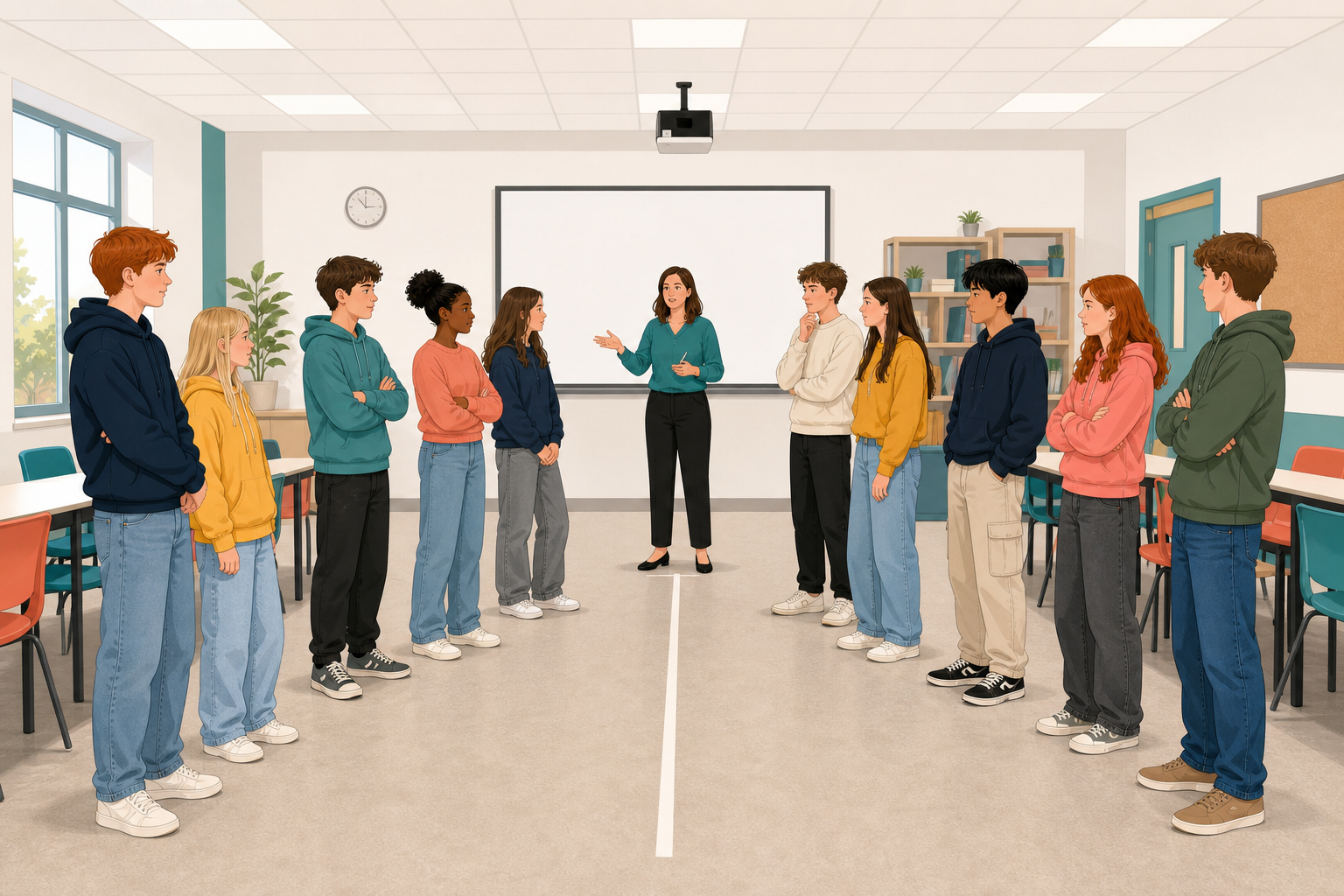
Below, you place a marker to show where you stand on the motion. Markers can move, and changing your mind is allowed.
Be ready to name one concrete reason drawn from what you have actually seen AI do: an AI answer you audited, synthetic media you judged, a real use you have tried, or something you saw when training, testing or fooling an image or pose model. Vague feelings do not count as a case.
If you need a starter, use: From the AI answer we audited that sounded sure but was wrong… or From the synthetic-media tell we judged… or From when we trained or tested the image / pose model…
First, place your marker on the statement without talking, so that the line shows what people think before anyone is talked round. Then listen while two or three voices from each end of the line give their strongest reason. When your teacher reveals the "things to think about" prompts, read them and move your marker if one of them has genuinely changed your mind.
Interactive activity
Now a short structured debate. You will be assigned the promise case or the pitfalls case (not your choice). You may be arguing a side you do not personally hold. That is deliberate: argue the strongest fair version of your side.
Read only your side's list. You will hear the other side's case when they speak.
Promise case (argue its strongest fair version)
- Creativity: starting points for writing, images and ideas, so more students can make something.
- Access: explanations on demand, and another way in when a topic will not stick.
- Speed: draft help and pattern-spotting that can free time for human judgement.
- Agency: used well, AI supports the checks and choices only a human can make.
- Good training data: when your image or pose examples were balanced, the model learnt the pattern you chose.
Pitfalls case (argue its strongest fair version)
- Confident errors: chat tools can sound sure while inventing facts - you practised verify or reject.
- Bias in, bias out: outputs skew when the data and design behind a system are unbalanced.
- Over-reliance: if a tool always drafts first, your own thinking gets less practice.
- Trust and media: synthetic images, voices and video make it harder to know what is real.
- Easy to fool: the image or pose model you tested could be tricked when examples were thin or unbalanced.
Do this now:
- First, pair up with someone on your own side, and take 2 minutes to pick the two points you will lead with and one piece of evidence from class work that backs them up. Note them as Point 1, Point 2, and then your evidence, finishing whichever of these fits your points: when we audited that AI answer, we found…, or when we judged that synthetic image, the tell was…, or when we trained and tested the model, what happened was…
- Next, each side nominates one opener (90 seconds) and a different replier (45 seconds). Every pair still preps, so that the nominees have plenty of points to use, and your teacher keeps time and calls those four speakers.
- Then the promise side speaks for 90 seconds while the pitfalls side only listens.
- After that the pitfalls side speaks for 90 seconds while the promise side only listens.
- Each side then gets a 45-second reply, aimed at the other side's strongest point rather than being a new speech.
- Finally, take 1 minute to place yourself again, silently, on the main motion (agree / disagree / not sure).
Pull the threads together. AI can open doors (creativity, access, speed, models that learn from balanced examples) and create real costs (errors that sound true, biased outputs, over-reliance, weaker trust in media, models that are easy to fool when data skews). Those are not slogans; several of them connect to answers you audited, media you have had to judge, and image or pose models you trained or tested.
Whether the advantages outweigh the disadvantages is still your call. What the course asks next is narrower and practical: one personal rule that keeps AI as a tool you think with, not a substitute that thinks for you.
Unlock the full learning experience
You're previewing this lesson. Get full access to this lesson and hundreds more — each one ready to teach, with interactive activities, printable resources and pupil progress tracking built in.
This lesson is copyright of 123Learn.ie 2017 - 2025. Unauthorised use, copying or distribution is not allowed.