1 - Introduction ~5 mins
Welcome
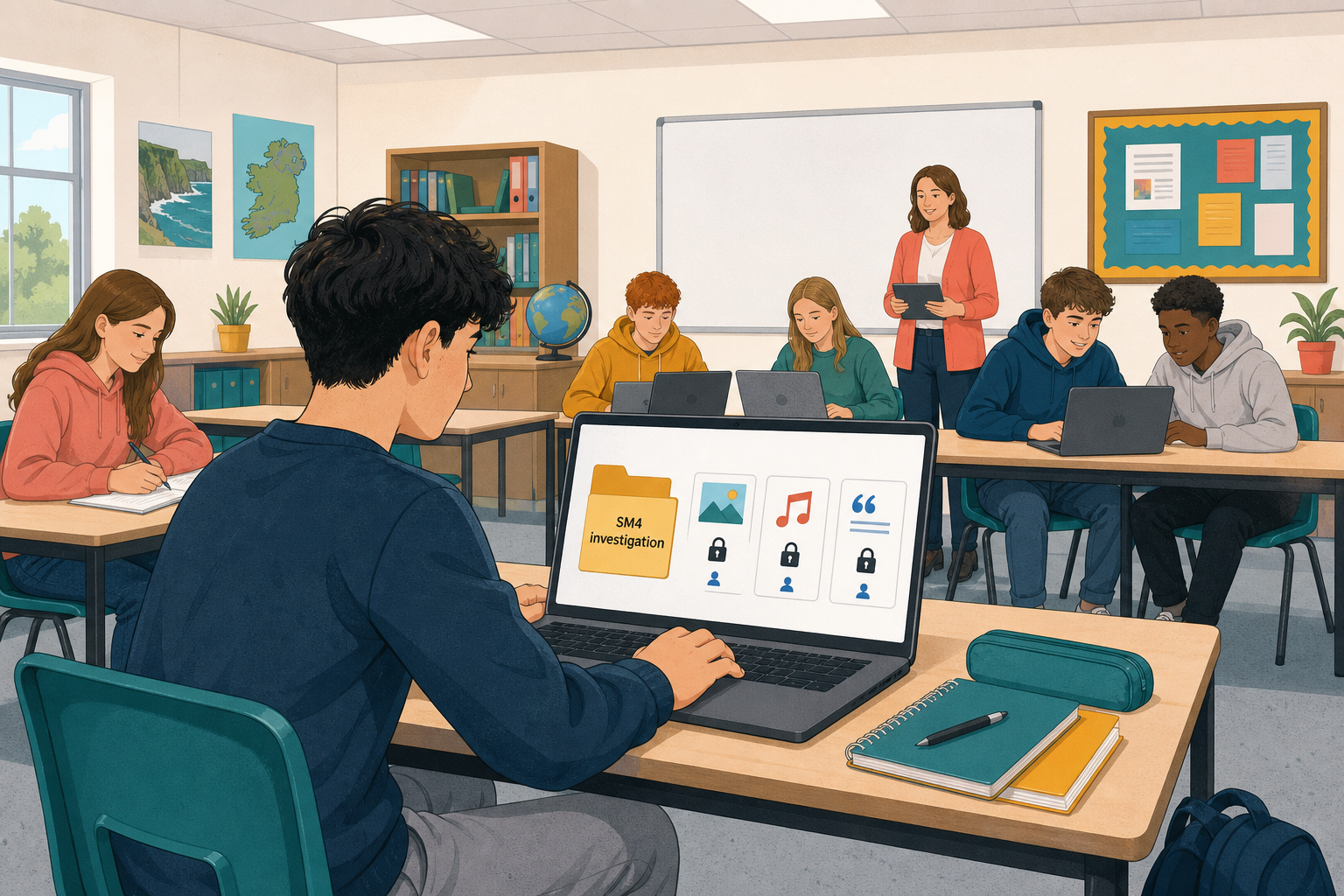 Your investigation is nearly ready to present, but every image, clip, and quoted line in it has an owner. Open the investigation work you have been building in {{code:Project_Portfolio}} → {{code:09_specialism/sm4/}} — that is your SM4 investigation folder. Today you sort real ownership situations as a class, then run a Rights Audit on the media already sitting there so you can defend every choice when a teacher, examiner, or workplace supervisor asks.
By the end of this lesson, you will be able to:
- Explain copyright basics for photos, music, and writing
- Distinguish public domain, citing, and copying
- Complete a Rights Audit for investigation images and media
Warm-up
Think of one image, logo, song, or paragraph you have already used (or planned to use) in your SM4 investigation. In your head, answer: who created it, and would you be comfortable showing that choice to the person who made it?
2 - Key Concepts ~6 mins
Before you sort the cards, get these four ideas clear. You will use them on every image and clip in your investigation. Stay with these four buckets today (own work, public domain, cite or follow a licence, not allowed). Finer Creative Commons licence names come in a later lesson.
| Concept | Why it matters | Example |
|---|---|---|
| Copyright — the legal right that lets the creator control how a photo, song, video, or piece of writing is copied, shared, or reused Plain version: the maker decides who can reuse it. |
Using someone else's work without a legitimate basis can sink a Key Assignment, a Work Experience pitch, or a public post | A photo a local café posts on Instagram is still owned by the photographer or the business, even if it is easy to save |
| Public domain — work free of copyright (for example very old writing, or material the owner has released) so anyone may reuse it Plain version: nobody owns the copyright any more, so reuse is open. |
Saves you from needing permission, but you still name the source so your investigation stays honest | A nineteenth-century poem, or an image clearly marked as public domain on a trusted archive |
| Citing versus copying — citing names the source beside a short quote or paraphrase; copying pastes large chunks as if they were yours Plain version: short quote with a name is citing; dumping a full chunk with no name is copying. |
Examiners and employers treat uncredited copying as plagiarism; a short cited quote shows you can use evidence properly | One sentence from a Citizens Information page with author, title, and date beside it is citing; a full paragraph pasted in with no name is copying |
| Licence and permission — a licence (for example Creative Commons) sets the reuse rules in advance; permission is a direct yes from the owner Plain version: written reuse rules, or a clear yes from the owner — "I found it on Google" is neither. |
"I found it on Google" is neither a licence nor permission, so it fails a Rights Audit | A Wikimedia Commons image marked CC BY is fine if you credit the photographer; a GAA club crest usually needs the club's say-so |
Sample Rights Audit entries
In Independent practice you will copy this exact four-column layout. Finished rows look like this — including one messy case that failed and was replaced:
| Image or media | Source | Licence type | Why this use is legitimate |
|---|---|---|---|
| Shop-front photo for enterprise pitch | Taken by me on placement, May | Own work | I created the photo, so I own the copyright and may use it in my investigation |
| County outline map | Wikimedia Commons, contributor named on file page | Named licence (credit the photographer) | Licence allows reuse with attribution; photographer credited beside the image |
| Local shop logo (rejected) | Saved from the shop homepage — no licence line | Not allowed yet | No licence or permission found, so I will not use it. Replaced with my own placement photo of the shop front |
When a real file has no licence line, treat it like the third row: reject it, say why, and swap in own work, public domain, or a clearly credited licensed file.
3 - Who Owns It, and Can You Use It? ~15 mins
As a class, sort eight real ownership situations into three buckets: free to use; OK for school use if you cite, credit, or follow the licence; or not allowed. Talk each card through before anyone locks a drop.
Who owns it, and can you use it?
4 - Common Issues ~4 mins
Common Issues
| Issue | Solution |
|---|---|
| I thought anything on Google Images was free | Search results are not a licence. Trace the file to its real page, read the reuse terms, or take your own photo instead |
| I credited the site but still used a full song or a full article | A credit does not unlock wholesale copying. Short cited quotes can be legitimate; full tracks and full pages usually need a licence or permission |
| I cannot find a licence line on the image I want | Treat missing terms as "not allowed yet". Swap it for your own photo, a clearly labelled public-domain file, or a Creative Commons file you can credit properly |
5 - Set up Your Rights Audit ~5 mins
Watch the short demo on the board, then create your own blank Rights Audit document with a four-column table. You will fill the rows in the next step. Match the sample layout from Key concepts.
Unlock the full learning experience
You're previewing this lesson. Get full access to this lesson and hundreds more — each one ready to teach, with interactive activities, printable resources and pupil progress tracking built in.
This lesson is copyright of 123Learn.ie 2017 - 2025. Unauthorised use, copying or distribution is not allowed.