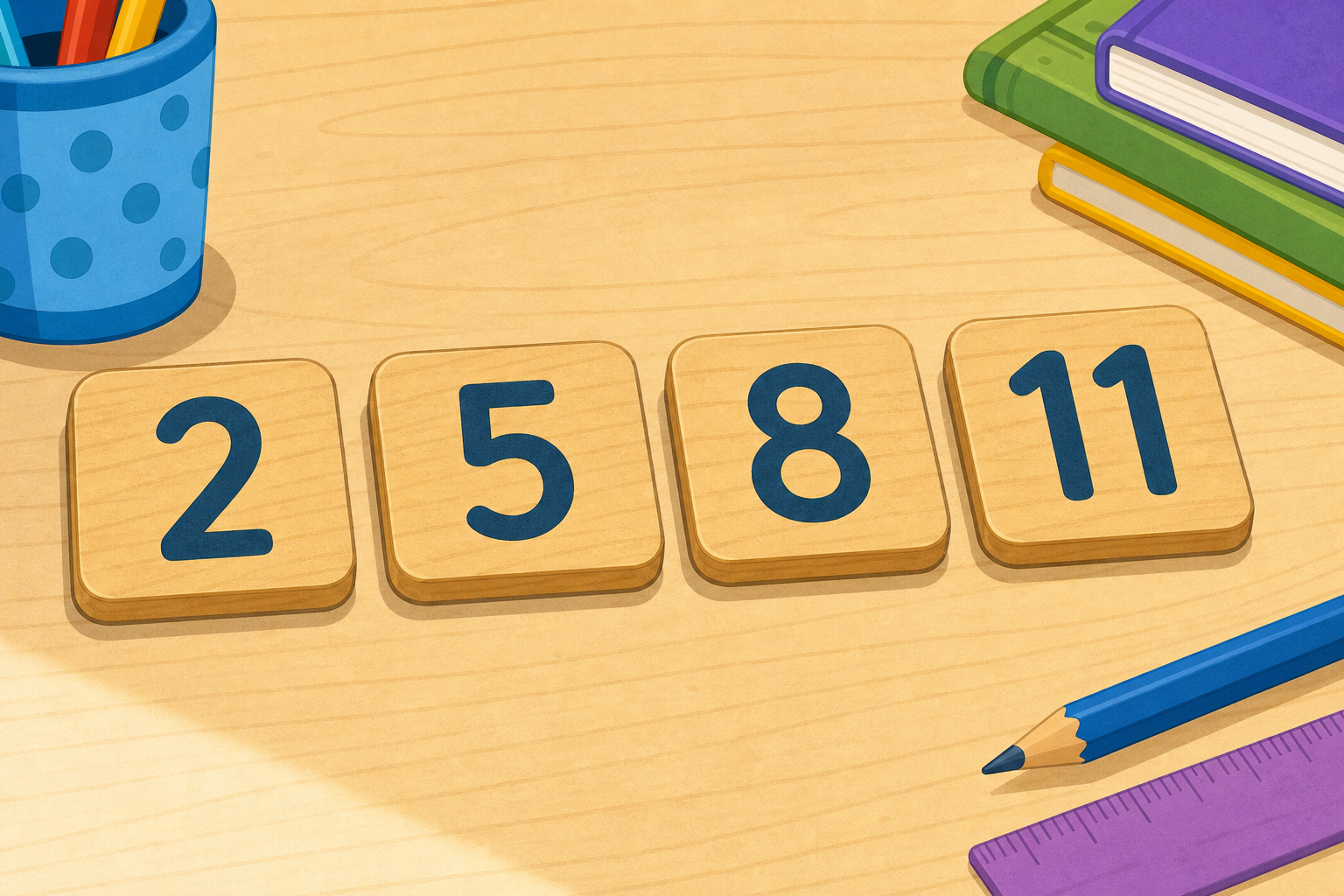
Look at this row of numbers: 2, 5, 8, 11. Each number in the row is called a term: 2 is the first term, 5 is the second term, and so on. Something is happening as we move from one term to the next. What do you think comes after 11?
Think first, then hands up. What is the same each time you step from one term to the next?
Display 2, 5, 8, 11 and give five seconds of quiet think-time before any hands go up. Take two or three hands-up answers, not open call-outs.
Listen for whether pupils are spotting the jump of 3 or just guessing the next number. Don't confirm the rule yet — that lands in the next step.
A function machine takes a number in, does the same rule to it every time, and sends a new number out. Watch what each machine does.
Watch the machine take 2 and turn it into 5, then 5 into 8, then 8 into 11. The same thing happens every step. What is the machine doing to each number?
This machine works differently. Watch how each number doubles to make the next one. The jumps get bigger and bigger.
This machine goes the other way. Each number gets smaller by the same amount. What comes after 35?
This last machine does two things to each number. Let's follow one step on screen: take 7, double it to make 14, then add 1 to make 15. So the rule is double, then add 1. Can you see both steps?
Walk each machine aloud, one at a time.
Now we explore a hidden-rule machine together on the board. A number goes in, a different number comes out, and the same rule works every time.
Someone picks a number to put in. Before we press it through, the class predicts the number that will come out and says why. Then we reveal it and check.
This round is for talking it through together — pupils take turns at the board choosing an input, and the class predicts the output and agrees or corrects out loud.
Send single-digit and two-digit inputs through so the rule shows up clearly. Before each reveal, ask the class to predict the output and say why. Revoice a strong answer: 'so the rule adds three every time, no matter what number we start with.'
Watch for pupils who only look at the last output and copy the jump without checking it holds for a new input.
In your maths copy, write each of these sequences' first three terms and continue each one for two more terms. Underneath each sequence, write the rule you spotted in words.
Walk the room glancing at whether the written rule actually matches the numbers pupils continued — this is whole-class copybook practice, not marking.
Now we try a machine that does two things to each number, just like the 'double then add 1' machine we watched.
Someone puts a number in. Before we reveal the answer, the class works out both steps out loud: first the doubling, then the adding. Then we check the machine agrees with us.
This is the bridge between watching a two-step rule and cracking one alone. Keep it on the 'double then add 1' rule so pupils practise the exact reasoning before the challenge.
Choose an input, then ask the class for step one ('double it') and step two ('add 1') before revealing. Revoice: 'double the 4 makes 8, add 1 makes 9.' Run two or three inputs so the class has done it before solving one independently.
Now we work through these hidden-rule machines together. Each one keeps its rule secret. We probe a few inputs, work out the rule, then check it on the next number.
The last machine uses two steps, so look carefully — it does more than one thing to each number.
This round is the practice bank — pupils take turns at the board, check each answer, and the class confirms before moving on. Keep the board work brisk rather than over-explaining.
Build from the friendly single-step rules to the two-step rule at the end. On a miss the machine names an input the guess gets wrong — use that as the teaching point rather than just saying 'wrong'. For the final 'double then add 1' machine, draw out both operations explicitly the same way we practised.
How do you check whether your rule is the right one? One pupil says a rule works if it fits the very last number. Another says you have to test it on every number. Who is right, and how would you settle it?
Listen for pupils who realise one matching jump is not enough — a rule has to hold for the whole sequence. Revoice: 'so we test the rule on every step, not just the last one.'
If a pupil offers a wrong rule that happens to fit two terms, use it: try it on a third term so the class sees it break.
Next we will get better at putting a rule into clear words — naming both the action and the amount — so that someone else can use your rule to continue the pattern without any help.
Keep this brief. Restate the 'test it on every step' idea once more so it carries into the next lesson on describing rules precisely in words.
You're previewing this lesson. Get full access to this lesson and hundreds more — each one ready to teach, with interactive activities, printable resources and pupil progress tracking built in.