Mathematics
Intermediate
50 mins
Teacher/Student led
+80 XP
What you need:
IWB/Projector/Large Screen

Constructing and Interpreting Bar and Multiple Bar Charts

Learn to construct and read multiple bar charts that compare two groups side by side on the same axes. You'll label axes, create a key, find where two groups differ most, and, for before-and-after data, say which preference changed most.
Teacher Class Feed

Load previous activity

    1 - Getting Started ~4 mins

    Illustration for Getting StartedHere is a bar chart showing the favourite sports of one class. It does its job for one group. But what if we wanted to show our class and the class next door on the very same chart, so we could compare them at a glance?

    How could we fit two groups onto one set of axes without it turning into a mess?

    2 - Watch and Notice ~11 mins

    One group: favourite sports

    First, watch this ordinary bar chart. One bar per sport, one group. Notice how the scale up the side goes up in steps you can read off easily.

    Two groups: lunch choices in two classes

    Now watch this one. For every lunch choice there are two bars side by side, coloured differently. A small key in the corner tells us which colour is 6th Class and which is 5th Class. This is a multiple bar chart, and it lets us compare the two classes choice by choice.

    A scale that jumps in 5s

    Last, look at this chart where the side scale climbs in 5s. The biggest bar is near 18, so counting one-by-one would be slow. Steps of 5 keep the chart tidy and still let us read every bar.

    Finding the biggest difference between two groups

    Now we put a really useful idea on the board. Look at this chart comparing two classes on after-school clubs. For each club, both bars sit side by side, so we can measure the gap between them. For art the two bars are almost level, so the gap is small. For coding the blue bar is far taller than the orange one, so that gap is large. When we look right across the chart and ask where the two classes differ most, the answer is the category with the biggest gap. Here that is coding. Notice this finds a category, not a group: the two classes simply differ most for coding.

    3 - Try It Together ~9 mins

    Today we build a multiple bar chart together, starting from an empty grid. Our data compares two classes on how they travel to school: walk, cycle, car. The chart begins blank, and as the class reads out each number we set that bar's height, colour the two groups differently, and add a key so anyone could read it.

    Our data

    In 6th Class, ten pupils walk, six cycle and eight come by car. In 5th Class, seven walk, four cycle and twelve come by car.

    How two classes travel to school

    4 - Sketch the Chart in Your Copy ~3 mins

    COPYBOOK MOMENT

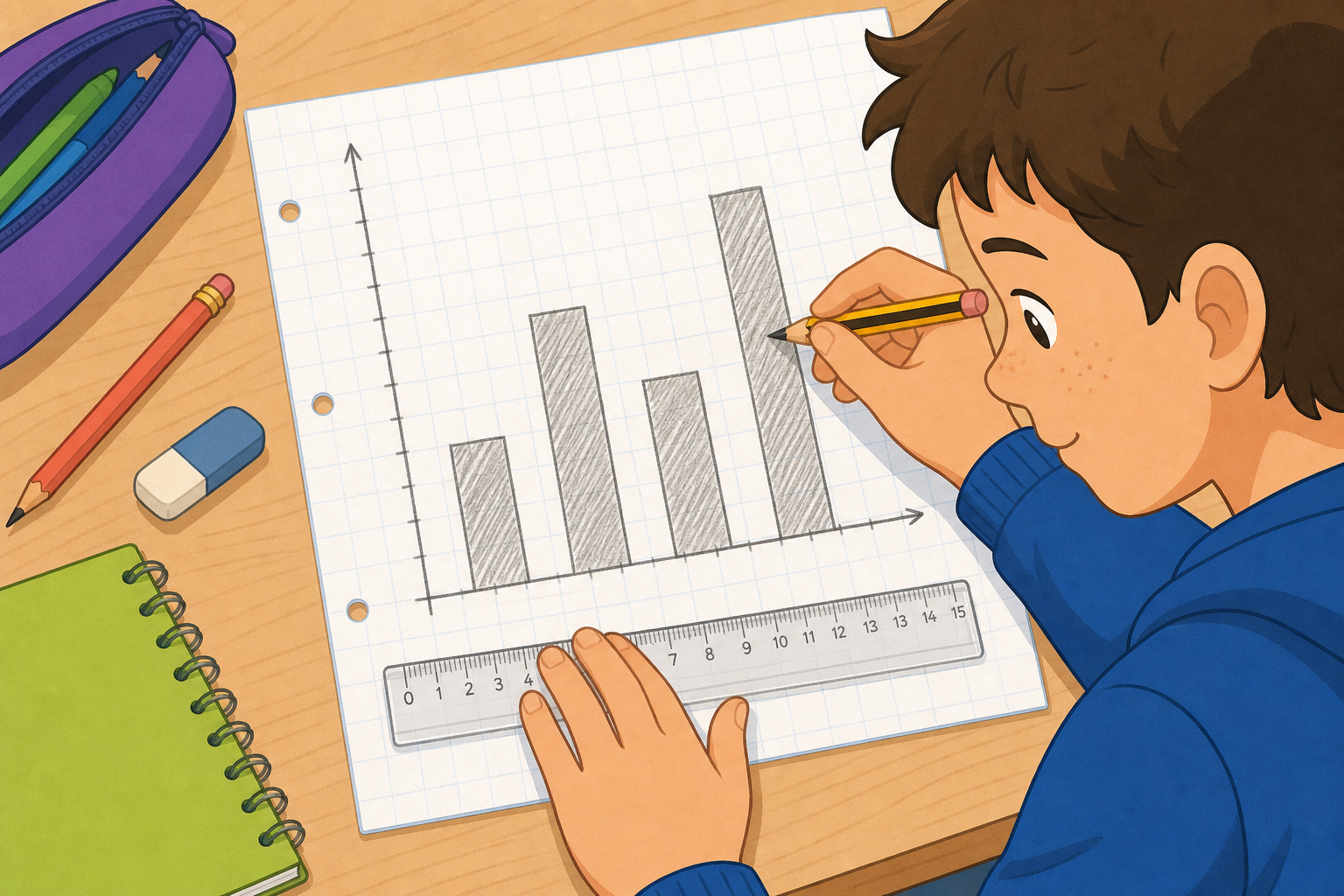
    In your maths copy, sketch a multiple bar chart for the two-class travel data. Use a clear scale up the side and draw two bars side by side for each way of travelling. Label both axes, and add a small key to show which colour is which class.

    5 - Class Challenge ~8 mins

    Today we work through four multiple bar charts together, building each one and then reading it carefully before we check.

    • First we build favourite fruit for two classes, then read in which fruit the two classes differ most.
    • Next we build pets in two classes, and find the category with the biggest difference between them.
    • Then two weekend clubs and their activities, again finding the biggest difference between the groups.
    • Last, a before-and-after chart: favourite subject before a school project and after it. Because these two bars are the same group at two different times, here we ask the trickiest question of all — which subject's preference changed most.

    Build and read the charts

    6 - What Did We Notice? ~3 mins

    MATHS TALK

    Why does a multiple bar chart need a key, when a single bar chart does not? And when we compare two groups, what exactly do we look at on the chart to find where they differ most?

    7 - What's Next ~2 mins

    Today's key points

    • A multiple bar chart compares two groups by drawing their bars side by side for each category.
    • A key is essential so the reader knows which colour belongs to which group.
    • A sensible scale, going up in equal steps, lets every bar be read fairly.
    • To find where two groups differ most, look for the category with the biggest gap between its two bars.
    • When the two bars are the same group measured before and after, that biggest gap tells us which preference changed most.

    Coming up

    Coming up

    Next we move from bars to lines: trend graphs that show how one quantity changes over time, and what the slope of the line tells us.

    Pupil practice
    Module 9 · Data and Chance Mixed
    Lesson 94 · Constructing and Interpreting Bar and Multiple Bar Charts
    Download Activity Book page (PDF)
    End of lesson
    123learn · Online learning platform

    Unlock the full learning experience

    You're previewing this lesson. Get full access to this lesson and hundreds more — each one ready to teach, with interactive activities, printable resources and pupil progress tracking built in.

    Hundreds of curriculum-aligned lessons
    Interactive activities in every lesson
    Printable resources & progress tracking
    Copyright Notice
    This lesson is copyright of 123Learn.ie 2017 - 2025. Unauthorised use, copying or distribution is not allowed.
    🍪 Our website uses cookies to make your browsing experience better. By using our website you agree to our use of cookies. Learn more
