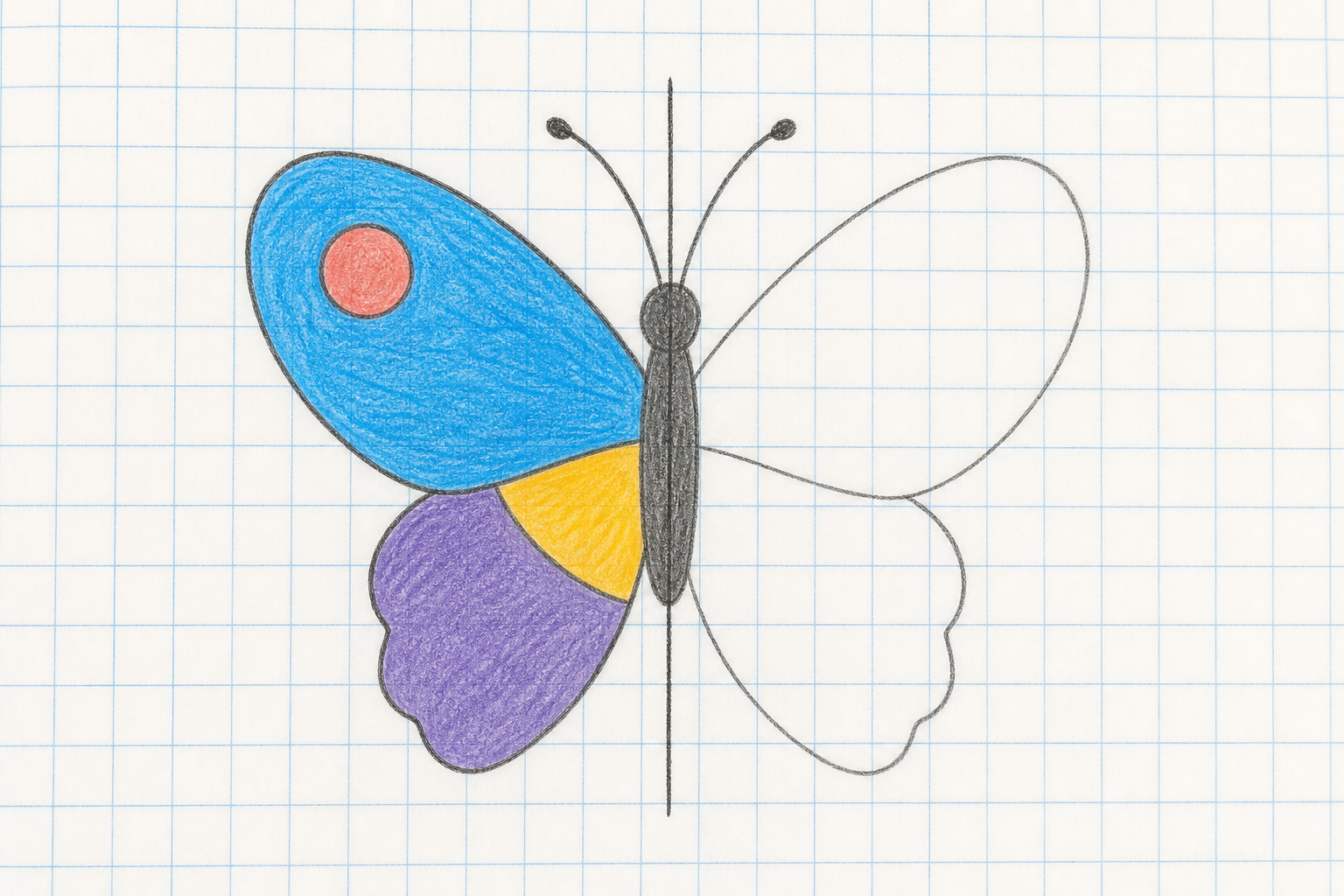
Here is half a butterfly. A straight mirror line runs down the middle of its body, and one wing is missing a coloured spot.
Look closely: the spot on the wing we can see sits a few squares out from the line. Where must the missing spot go on the other wing so the butterfly matches itself perfectly?
Show the half-butterfly image as pupils settle. Take two or three hands-up answers, not open call-outs. Don't reveal the rule yet — just let them sense that the missing spot has to sit the same distance from the line, on the opposite side.
Watch as a single coloured square sits one square to the left of the mirror line. Its mirror square goes one square to the right. Same distance, opposite side.
Now a square sits three squares from the line. Count carefully: its mirror goes three squares back the other way. The number of squares from the line is what matters.
This time three squares make an L. Each square is reflected on its own, counting its own distance from the line. The whole L flips to face the other way.
Here a square sits right on the mirror line itself. A square on the line stays exactly where it is — it is its own mirror.
Walk each example aloud, one at a time, pointing at the squares and counting from the line each time.
This is a static display — point and narrate, do not drag. The L-shape and on-the-line examples are the hardest, so keep the earlier two brisk and slow down here.
Today we work through this together: a few squares are coloured on one side of the mirror line, and we complete the other side so the pattern is symmetrical.
For each square we count how far it sits from the line, then place its mirror exactly the same number of squares away on the opposite side. Take your turn at the board and the class will agree or correct.
This round is for talking it through together — pupils take turns at the board and the class agrees or corrects out loud.
Place two or three squares on one side, then call a pupil up to reflect each one. Ask the class to count the distance aloud before each placement: 'how many squares out is this one?' Watch for the common slip of placing the mirror one square too near or too far from the line — catch it by re-counting together. Rotate a few pupils through the placements.
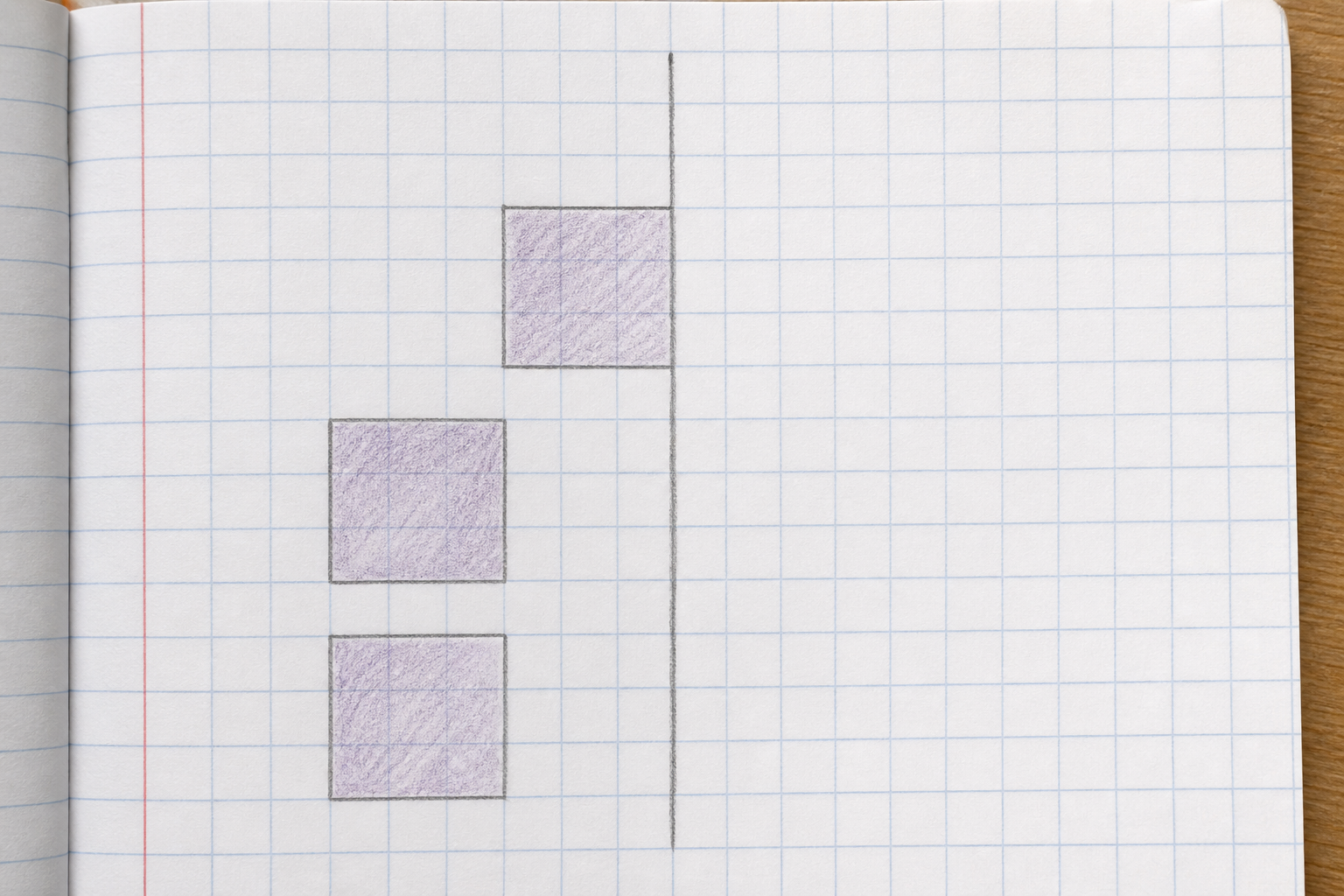
In your maths copy on squared paper, draw a straight vertical mirror line down the middle of the page.
Colour three squares on the left of the line. Then shade their mirror squares on the right so the whole pattern is symmetrical. Count carefully each time: the same number of squares from the line, on the opposite side.
Walk the room glancing at the distance count on each reflected square — this is whole-class copybook practice, not marking. The slip to catch is a mirror square placed one square off; nudge the pupil to re-count from the line.
Today we work through these patterns together, each one a little trickier than the last: a four-square pattern, then a six-square pattern, then a pattern with a square sitting right on the mirror line.
Take your turn at the board, complete the pattern, then we check it before moving on.
This round is the practice bank — pupils take turns at the board, check each answer, and the class confirms before moving on. Keep the board work brisk rather than over-explaining.
The square-on-the-line round is the make-or-break check: that square sits on the line and does not move. Re-count distances aloud whenever a placement wobbles, and ask the class to predict before confirming each answer.
You're previewing this lesson. Get full access to this lesson and hundreds more — each one ready to teach, with interactive activities, printable resources and pupil progress tracking built in.