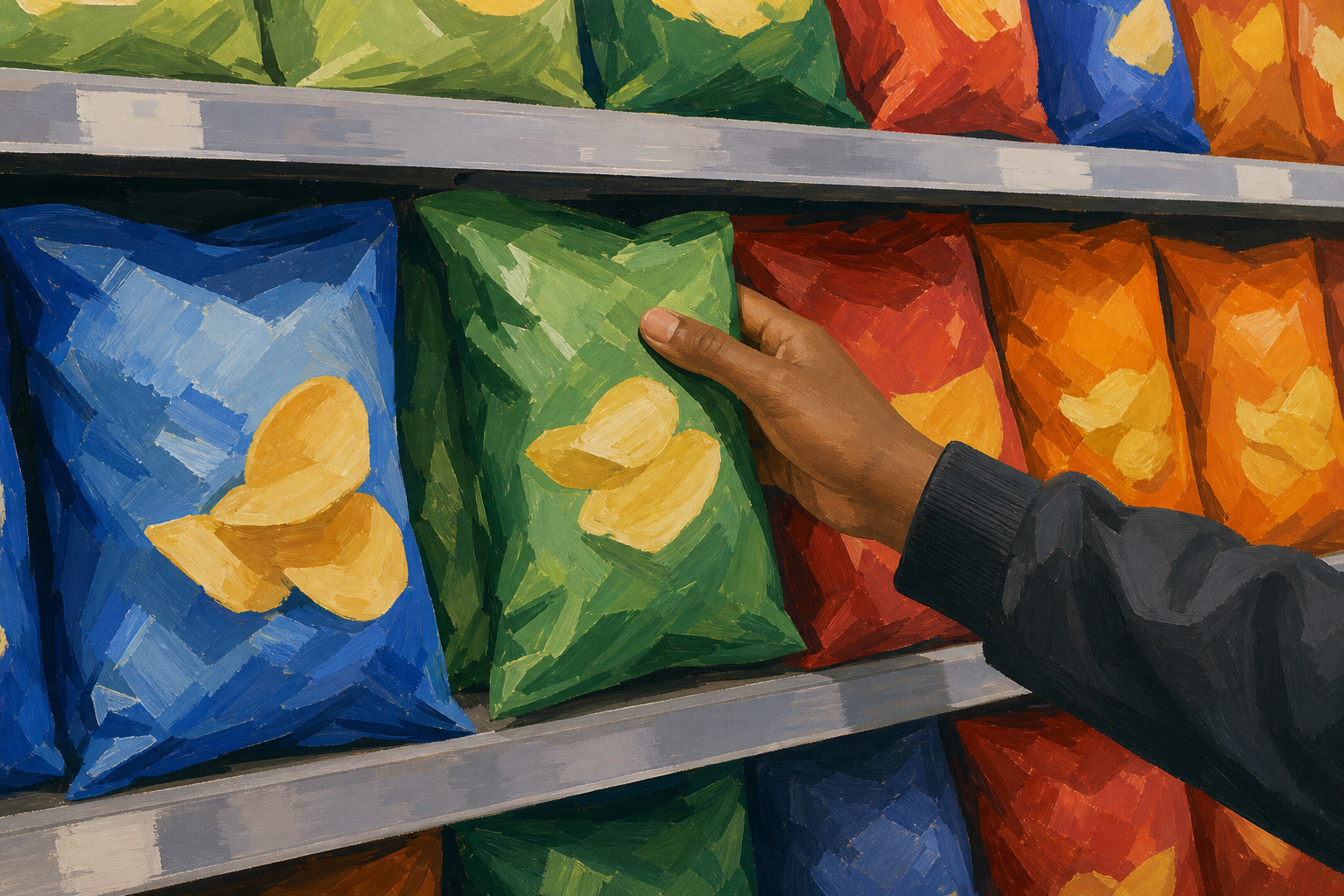
You walk into a Centra on the way home. You are in front of the crisp shelf. Six brands, three flavours each, eighteen choices. You reach for one without reading the label. Tayto, maybe. Or whichever one your mam always buys. You did not decide in that moment. Your brain had already decided, months or years ago, based on the brand.


That instant choice did not happen by accident. The company behind that packet made a long list of careful decisions: what the product is, what it costs, where it sits on the shelf, how they tell people about it. Today you are going to make those same decisions for your own mini-business.
By the end of this lesson, you will have a brand name, a one-sentence marketing message that names your customer and the benefit, a complete 4Ps grid, and a real social-media post you could actually send. All of it lands on the Marketing Page of your portfolio.
Marketing has a famous shorthand called the 4Ps. Together with a clear brand, these are the five decisions every business makes about how it reaches and convinces customers.
| Concept | Why it matters | Example |
|---|---|---|
| Branding — the identity (name, look, voice) that makes a business instantly recognisable and tells customers what to expect | Customers buy from brands they recognise, often even at higher prices. A strong brand is a shortcut in the customer's head from "I see this" to "I trust this" | Kerrygold's gold foil packaging and the word "gold" itself signal premium Irish butter; the supermarket own-brand block signals everyday and cheaper. Same product category, very different brand promise |
| Product (1st P) — what you actually sell, including features, quality, size and packaging | If the product is not right for your customer, no clever price or promotion will save it. The product is the foundation everything else rests on | A TY mini-company's hot chocolate is not just brown liquid: it is a 250ml warm drink in a recyclable cup, served at GAA matches in January when parents are freezing |
| Price (2nd P) — what you charge, and what that price signals to the customer | Price is not just a number. It tells the customer whether you are "premium", "everyday" or "suspiciously cheap". The wrong price kills a great product | Cold parents on a sideline pay €3 for a hot chocolate without thinking. €5 feels like a rip-off; €1.50 makes them wonder what is wrong with it |
| Place (3rd P) — where the customer finds and buys your product, and how easy you make that | A great product that the customer cannot reach is a failed product. Place is the answer to "how does it get from you to them?" | A stall at the GAA club gate on a Saturday morning works. The same hot chocolate from your kitchen at home does not — the customer cannot reach you |
| Promotion (4th P) — how you tell people you exist and persuade them to choose you | Customers cannot buy what they do not know exists. Promotion closes the gap between "never heard of them" and "walking toward their stall" | One Instagram post the evening before a match, tagged at the GAA club, lands the news with exactly the parents who will be on the sideline tomorrow |
Notice how the four Ps have to agree with each other. A premium price needs a premium-looking product, a premium place to sell it from, and promotion that feels premium too. If the Ps fight each other (premium price, scruffy stall, no signs), customers feel something is off and walk past.

Meet Match Day Hot Choc, a fictional TY mini-company set up by three students. They sell hot chocolate at their local GAA club's home matches between October and February. Here is how they made every brand and 4Ps decision.
| P | Their decision | Why this works for the customer |
|---|---|---|
| Product | 250ml warm chocolate, served in a recyclable cup with a heat-protecting sleeve. Whipped cream optional for €0.50 extra | Cold parents want warmth and something to wrap their hands around. The sleeve is as important as the drink |
| Price | €3 per cup. Costs them €1.05 per cup to make (from their Budget Sheet), so profit per cup is €1.95 | €3 is the impulse-buy ceiling — parents do not stop to think about it. €5 would feel like getting ripped off at a match |
| Place | A small folding stall at the GAA club gate, set up 30 minutes before each home match, packed away at half-time when most cups are sold | The customer literally walks past them on the way in. They cannot miss them, they do not have to detour, they do not have to queue inside the clubhouse |
| Promotion | A poster pinned inside the clubhouse all season + one Instagram post the evening before each match, tagging the club | The poster reminds existing visitors; the Instagram post lands with exactly the parents who will be there tomorrow. They are not trying to reach the whole of Ireland |
Answer to the prediction: at €5, the Place would break first. A folding stall at a GAA gate signals "casual, impulse, hands-cold". €5 signals "sit-down café". The two would fight each other and customers would walk past. (You could also argue Promotion breaks — an Instagram caption that says "€5 hot chocolate" doesn't get parents to stop scrolling.)
That principle — every P has to agree with every other P — is what makes the social post work too. Here is the post Match Day Hot Choc drafted.
Notice how every part agrees. The product is hands-on-cup warmth. The price is impulse-buy. The place is right in the customer's path. The promotion lands the evening before, in the place the customer is already scrolling. The social post extends the same message: cold sidelines, warm cup, see you tomorrow. No part of this fights any other part.
That is your job in the next two steps: make all five decisions for your own mini-business so they all agree with each other.
Now apply the 4Ps to your own mini-business. You have already chosen the idea, defined your customer, built the business model, and worked out the price and costs earlier in this unit. The 4Ps pulls all of that into one marketing-shaped grid.
Instructions: The four Ps are already labelled in the first column. Fill in your decision in column 2 and your reason in column 3, going in order:
For the third column, do not just describe — explain why that choice is right for your Customer Persona. The Why column is what makes the difference between a marketing plan and a list of guesses.
Digital Worksheet (ComparisonTable): Students complete this directly in the lesson. Their responses auto-save as they type — no printing required.