Here is the tally we collected for how the class gets to school: Walk has 12, Cycle has 5, Bus has 8, Car has 3. A tally is great for counting, but it is hard to tell at a glance which way is the most popular. What is the same and what is different about these four counts? Which one would be the tallest if we drew it as a picture?
Display the four tally counts as the class settles. Take two or three hands-up answers to 'which would be tallest?' — you want pupils predicting Walk before any chart appears, so the bar chart confirms a prediction rather than arriving cold.
Watch as each bar grows to match a tally count. The Walk bar reaches up to 12, the Cycle bar to 5, the Bus bar to 8 and the Car bar to 3. Notice that the height of each bar tells the story instantly — Walk is the tallest, so it is the most popular. Before we move on, who can tell me which is the shortest, just by looking?
Here is a different survey, this time about favourite fruit. Nine pupils picked apple, four picked banana, six picked orange and two picked pear. Look at how the bars sit on the bottom axis side by side, and how each one lines up with a number on the side scale. Turn and tell the person you are facing which fruit came second.
This chart shows four bars for car colours. All four bars are drawn for you. Read the Green bar: follow its top across to the side scale. What number does it reach? We can read any bar this way, just by following its top to the side scale.
Walk each chart aloud, one at a time, and pause for the turn-and-name on each.
Today we build the bar chart for our travel-to-school tally together. The counts are Walk 12, Cycle 5, Bus 8, Car 3. We will drag each bar up until its height matches the count, then read it back to check it lines up with the right number on the side scale.
This round is for talking it through together — pupils take turns at the board and the class agrees or corrects out loud.
Call one pupil up per bar. Before they drag, ask the class 'how high should this one go?' so the whole room predicts. After each bar lands, read it back down to the scale to confirm. Watch for pupils who drag a bar to the wrong gridline — the side scale steps in twos here, so Walk at 12 is six gridlines up, not twelve.
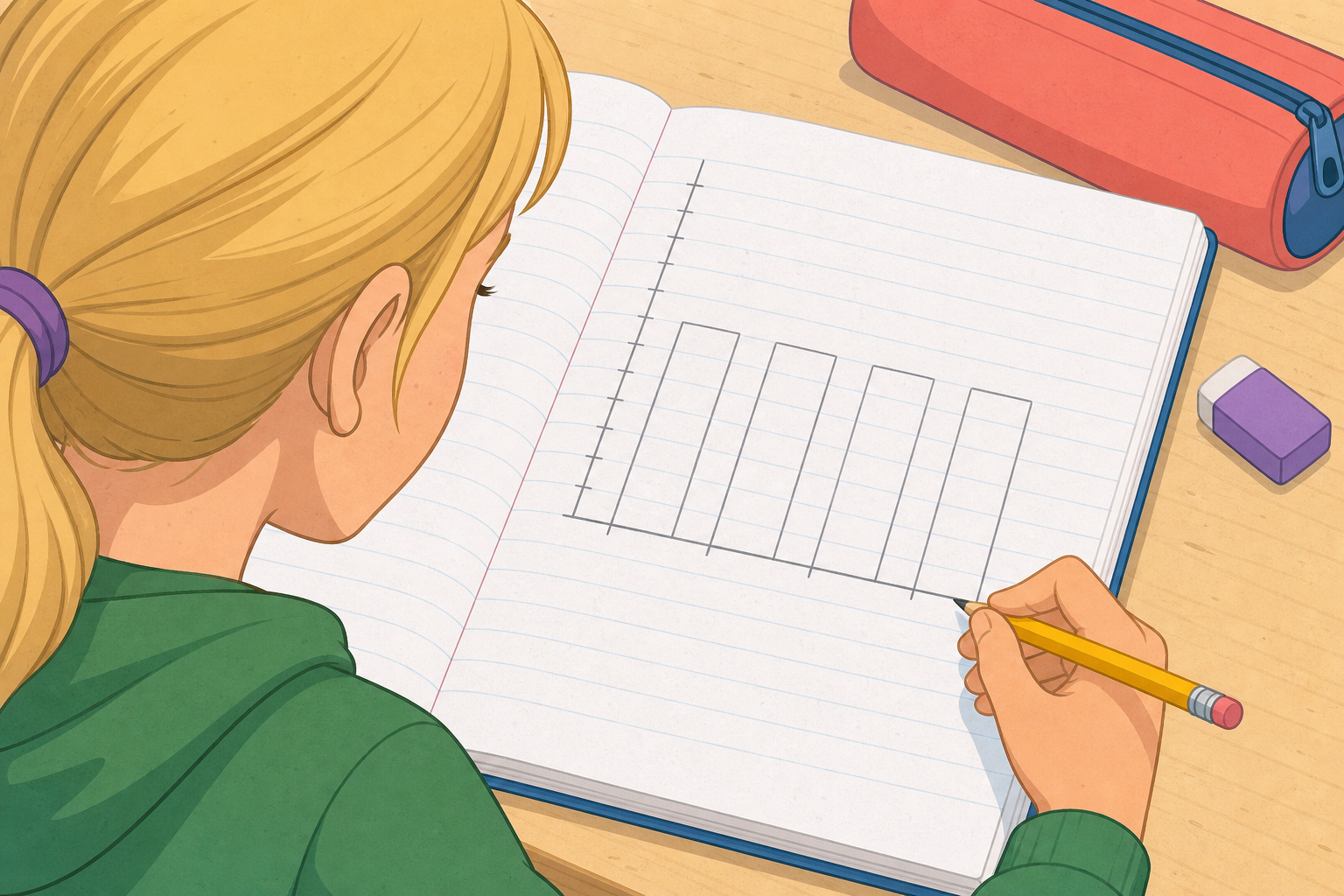
In your maths copy, sketch the bar chart frame: a side scale going up in twos (0, 2, 4, 6, 8, 10, 12) and the four labels along the bottom — Walk, Cycle, Bus, Car. Now draw each bar to match the tally we collected: Walk 12, Cycle 5, Bus 8, Car 3. Label both axes.
Walk the room glancing for two things: bars drawn to the right height, and both axes labelled. This is whole-class copybook practice, not marking — no scores, just a quick nudge if a bar is well off.
We have a few bar-chart jobs to work through at the board, each one a little trickier. First, match a chart to its tally. Next, three bars are filled in and you read the fourth one off the side scale. Last, build a chart where two bars come out the same height. We will check each answer together before moving on.
This round is the practice bank — pupils take turns at the board, check each answer, and the class confirms before moving on. Keep the board work brisk rather than over-explaining.
For the read-the-fourth-bar task, point at the Pear bar already shown and trace its top across to the side scale: this is the same point-and-trace move from Watch and Notice, just on a new chart. For the tied-categories task, draw out that two bars of equal height is fine and common — it just means those two categories had the same count.
Why does the height of each bar tell the story so quickly? What would change if we made the bars wider instead of taller — would the chart still tell us who was most popular?
Listen for pupils naming height as the thing that carries the count — revoice: 'so taller means more, and we read the height off the side scale.' Head off the idea that a wider bar means more; width is just for spacing, it tells us nothing about the count.
Next we look at choosing a scale: what to do when one bar is huge and the others are tiny, so we can step the side scale in twos, fives or tens to make the chart easy to read.
Keep this brief. Tie the forward look to the read-the-fourth-bar and tied-bar tasks the class just did — choosing the right scale is the next thing that makes a chart readable.
You're previewing this lesson. Get full access to this lesson and hundreds more — each one ready to teach, with interactive activities, printable resources and pupil progress tracking built in.