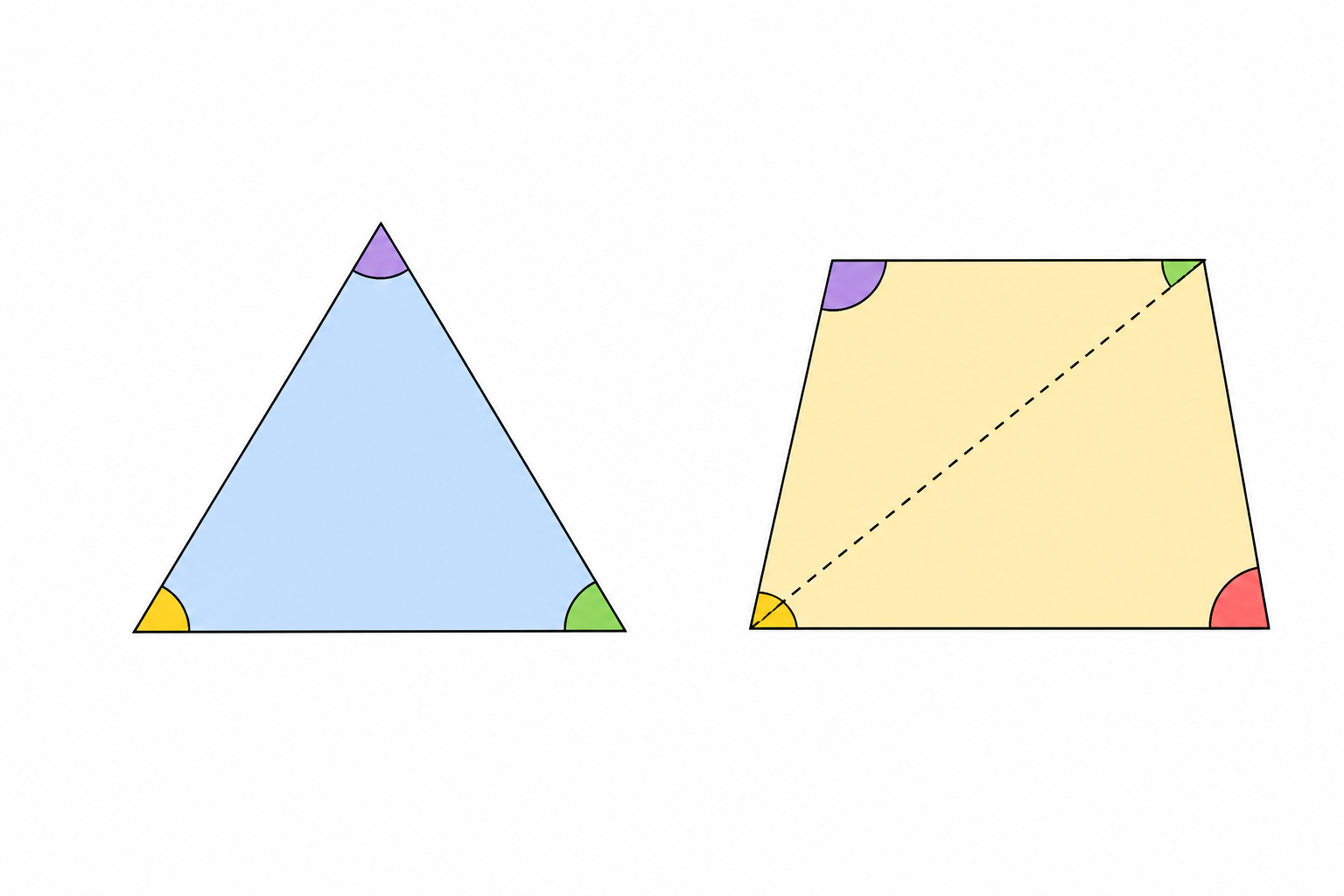
Here is a triangle. Before we work anything out: if I told you two of its angles, do you think you could work out the third one without measuring it? Have a think.
Now look at the four-sided shape beside it, and the dashed line running corner to corner. It splits the shape into two triangles. Keep that in the back of your mind, because it is going to tell us something surprising about the angles of a four-sided shape.
The interactive shows five shapes, one at a time: three triangles, then two four-sided shapes. Keep your eye on the total of the angles each time. What do you notice?
Today we drag the corners of a triangle and watch its angles change on the board. We'll pull one vertex to make it tall and pointy, then squash it flat and wide, then twist it into a shape none of us have seen before. Each time, before the numbers settle, predict what the total of the three angles will do.
The three angles will keep changing as we drag, but keep your eye on the running total. However sharp or squashed the triangle gets, we're checking whether that total ever leaves 180°.
In your maths copy, sketch one triangle and one quadrilateral. For each shape, write its angles in a column, one under the other. Add them up and underline the total at the bottom — 180° for your triangle, 360° for your quadrilateral.
You're previewing this lesson. Get full access to this lesson and hundreds more — each one ready to teach, with interactive activities, printable resources and pupil progress tracking built in.