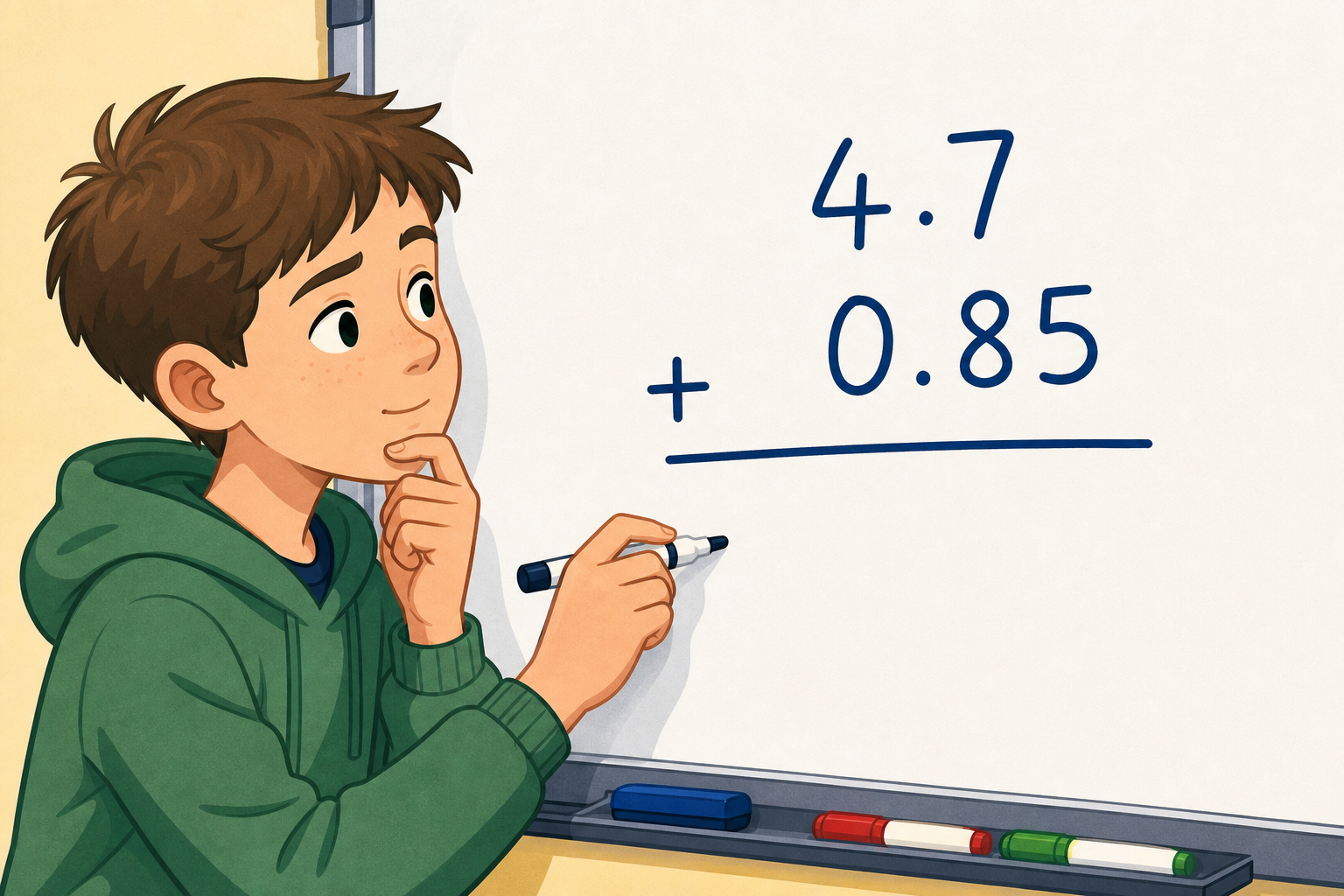
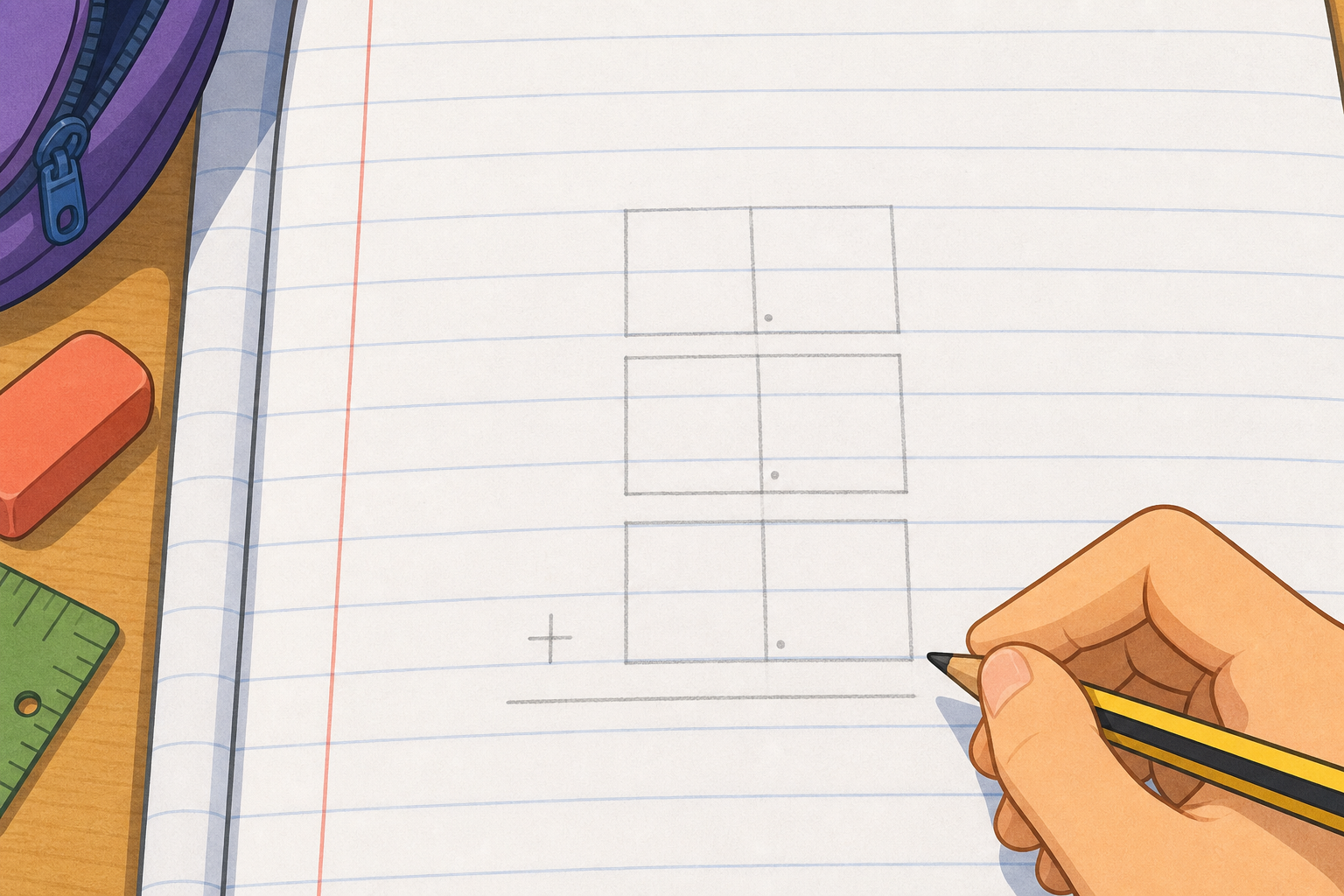
Here is a sum written out for adding: 4.7 + 0.85. But look closely at the way it is set up. Is this layout right? What looks wrong about how the two numbers are lined up?
Write 4.7 + 0.85 on the board stacked so the right-hand edges line up (so the 7 sits over the 5). Take three hands-up answers, not open call-outs. Listen for a pupil noticing the points don't match up. Don't fix it yet — that is the whole job of Watch and Notice.

Watch as we line up the decimal points one under the other. Lining up the points keeps tenths above tenths and hundredths above hundredths, so each column adds like-for-like. Once the points match, we can fill the empty hundredths place on 4.7 with a zero to make 4.70. Now every column has a digit to add.
Watch this one. The points line up, and 0.3 becomes 0.30 so there is a digit in the hundredths column.
This one is special. When we add the hundredths we get ten, so it regroups. Then the tenths regroup, then the units. Watch how the whole thing builds up to a clean ten.
Walk each example aloud, one at a time.
The trailing zero is the make-or-break move — keep coming back to it.
Today we work through these sums together: 1.05 + 2.34, then 0.6 + 0.27, then 4.8 + 3.65. For each one we will line up the decimal points first, add a trailing zero where a column is empty, then work each column from the right.
This round is for talking it through together — pupils take turns at the board and the class agrees or corrects out loud.
Let an individual pupil set each addend into the column-addition activity and step the columns. Before each column lands, ask the class to predict any carry. The 0.6 + 0.27 example has the lonely hundredth — watch pupils want to ignore the empty hundredths place; insist that 0.6 gets a placeholder zero (making 0.60). Revoice a good answer: 'so the point keeps everything lined up, and the empty place just gets a zero.'
In your maths copy, set up each decimal sum vertically with the decimal points lined up one under the other. Add a trailing zero to fill any empty column. Work each column with the class, and write the answer with its decimal point in the right place.
Walk the room glancing at whether the decimal points sit in a straight vertical line and whether the trailing zeros have gone in. No marking — this is whole-class copybook practice, not assessment.
Now we work through a short ladder of decimal sums together, each one a little harder than the last. For every sum we line up the points, fill any empty column with a zero, then add. We check each answer together before the next sum appears.
This round is the practice bank — pupils take turns at the board, check each answer, and the class confirms before moving on. Keep the board work brisk rather than over-explaining.
The bank rises from a clean tenths-only sum up to the cascade-regroup case. Watch for the 9.99 + 0.05 answer — pupils who forget the carry will write 9.104 instead of 10.04. When they slip, point back at the trailing-zero set-up rather than re-teaching from scratch.
Why is lining up the decimal points more important than lining up the right edge of the digits? What would go wrong if we lined up the edges instead?
Listen for pupils naming the decimal point as the thing that keeps tenths over tenths and hundredths over hundredths. Revoice a strong answer: 'so the point tells every digit which column it belongs to.' If a pupil says edges, gently show the 4.7 + 0.85 mis-set-up from Getting Started and let the class see the tenths landing in the hundredths place.
Next we look at subtracting decimals — the same line-up-the-points rule, with the same care for empty columns.
Keep this brisk. The trailing-zero habit is the one thing worth restating before pupils move to their activity-book practice.
You're previewing this lesson. Get full access to this lesson and hundreds more — each one ready to teach, with interactive activities, printable resources and pupil progress tracking built in.