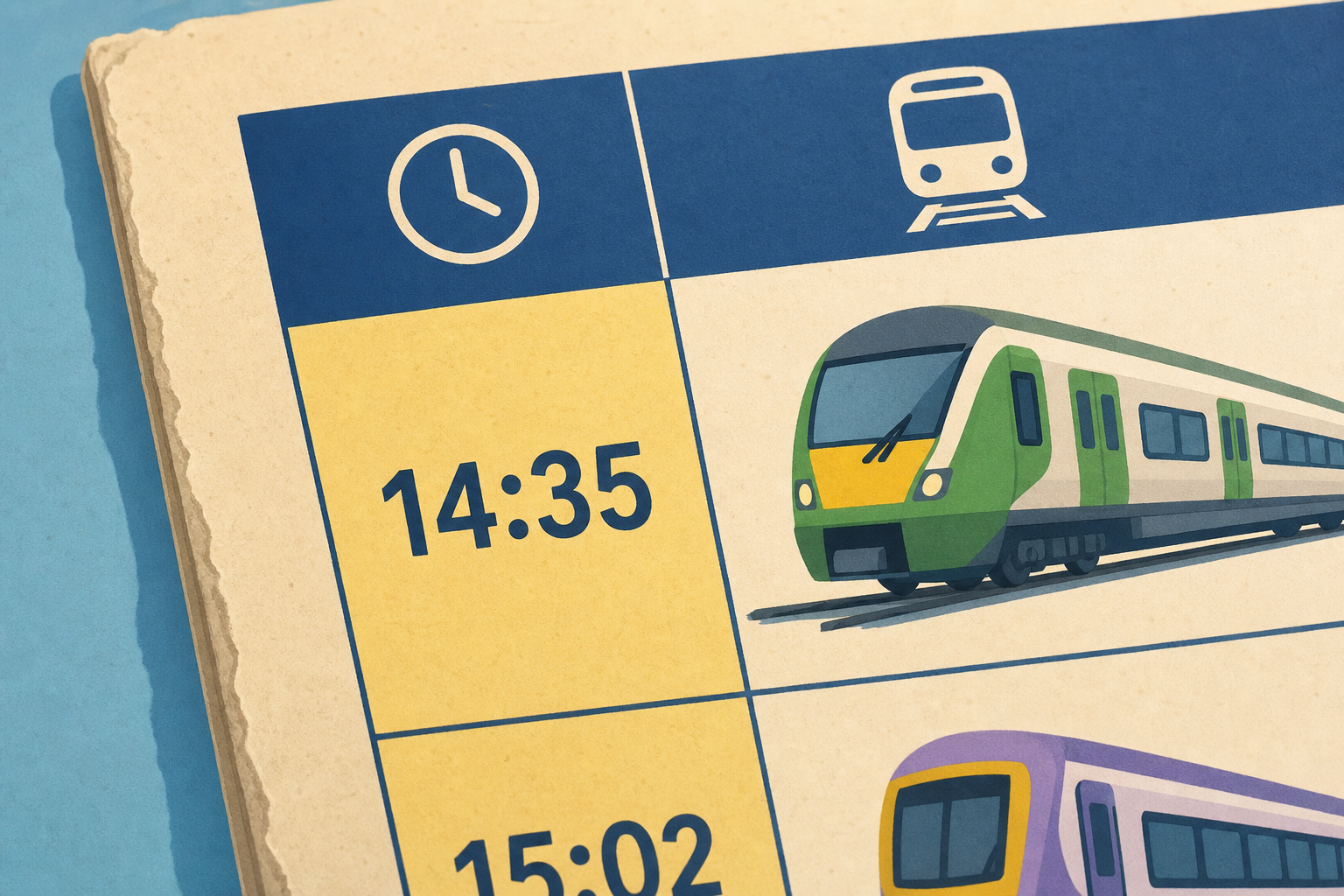
Here is a real Irish Rail timetable line: a train leaves at 14:35. What time of day is that? Is it morning, afternoon, or night? Hands up if you can tell me what o'clock 14:35 means on an ordinary clock.
Display the single timetable line 14:35 as pupils settle. Take three hands-up answers, not open call-outs. Don't confirm the answer yet — let the lesson build it. Listen for whoever says 'half two in the afternoon' and hold that thought.
Watch the clock. After midday the hours don't start again at 1 on the 24-hour clock. One o'clock in the afternoon becomes 13:00. What did we add to the 1 to get 13?
Now look at half past six in the evening. On the 24-hour clock that is 18:30. Notice the digital readout shows the same time the hands show.
Quarter past nine at night is 21:15. The same hands, a new number for the hour.
This one is tricky. Five minutes past midnight is not 24:05. Just after midnight the clock starts again from zero, so it reads 00:05.
Walk each example aloud, one at a time. The inner 13–24 ring and the digital readout are on so the afternoon and evening times read unambiguously from the face.
If the board interactive is unavailable, set each time on a large printed clock face and write the digital readout (e.g. 13:00) beside it on the board, so the class still sees the hands and the 24-hour number together.
Today we work through these four times together on the clock, in this order: 15:00, 19:45, 22:10, and the night-time edge 00:30. For each one we will say it the 24-hour way, then the 12-hour way with am or pm.
This round is for talking it through together — pupils take turns at the board and the class agrees or corrects out loud.
The clock is in 24-hour mode (inner ring + digital readout on). A pupil sets the hands or enters the time; the class names it both ways. Keep the +12 / −12 rule visible in pupil talk: '19 take away 12 is 7, so 19:45 is quarter to eight in the evening.' Catch the 00:30 trap — that is half past twelve at night, not half twelve in the day.
If the board interactive is unavailable, run the same four times on a large printed clock face: a pupil sets the hands and the class reads it both ways, while you write the 24-hour and 12-hour version side by side on the board.
In your maths copy, draw a two-column table. On the left write the 24-hour time; on the right write the same time the 12-hour way with am or pm. Fill in these four:
Then circle every time on your page that happens after midday.
Walk the room glancing at the two-column layout and the +12 conversions — this is whole-class copybook practice, not marking. Watch for anyone writing 24:05 for the midnight one and prompt quietly.
The printable Convert the Times sheet (see Before the Lesson) carries the same two-column table pre-drawn, so a pupil who finds the copy layout tricky, or any class without the board, can complete the identical conversions on paper.
Now we read times straight off the 24-hour clock and say them the ordinary way. For each one, set the hands, read the digital number, then tell us the 12-hour time with am or pm. Try these: 16:15, then 23:50, then the tricky 00:25 just after midnight, then 13:05.
This round is the practice bank — pupils take turns at the board, check each answer, and the class confirms before moving on. Keep the board work brisk rather than over-explaining.
Watch for these landing points:
If the board interactive is unavailable, call each 24-hour time aloud and have pupils set it on a printed clock face, then read it back the 12-hour way; or use the printable Convert the Times sheet rows for the same conversions.
Why does Irish Rail write 14:35 instead of 2:35 pm? What mistake does the 24-hour clock stop a traveller from making?
Listen for pupils naming the am/pm muddle — 2:35 could be the middle of the night or the middle of the afternoon, but 14:35 can only mean one thing. Revoice a strong answer: 'so the 24-hour clock removes the guessing — every time means exactly one moment in the day.' Head off the idea that 24-hour time is harder; it is just clearer.
Next we use these 24-hour times to work out how long a journey takes — counting on from a departure time to an arrival time within an hour.
Keep this brisk. Re-anchor the +12 / −12 rule one last time and flag the past-midnight 00:05 case as the one to remember.
You're previewing this lesson. Get full access to this lesson and hundreds more — each one ready to teach, with interactive activities, printable resources and pupil progress tracking built in.