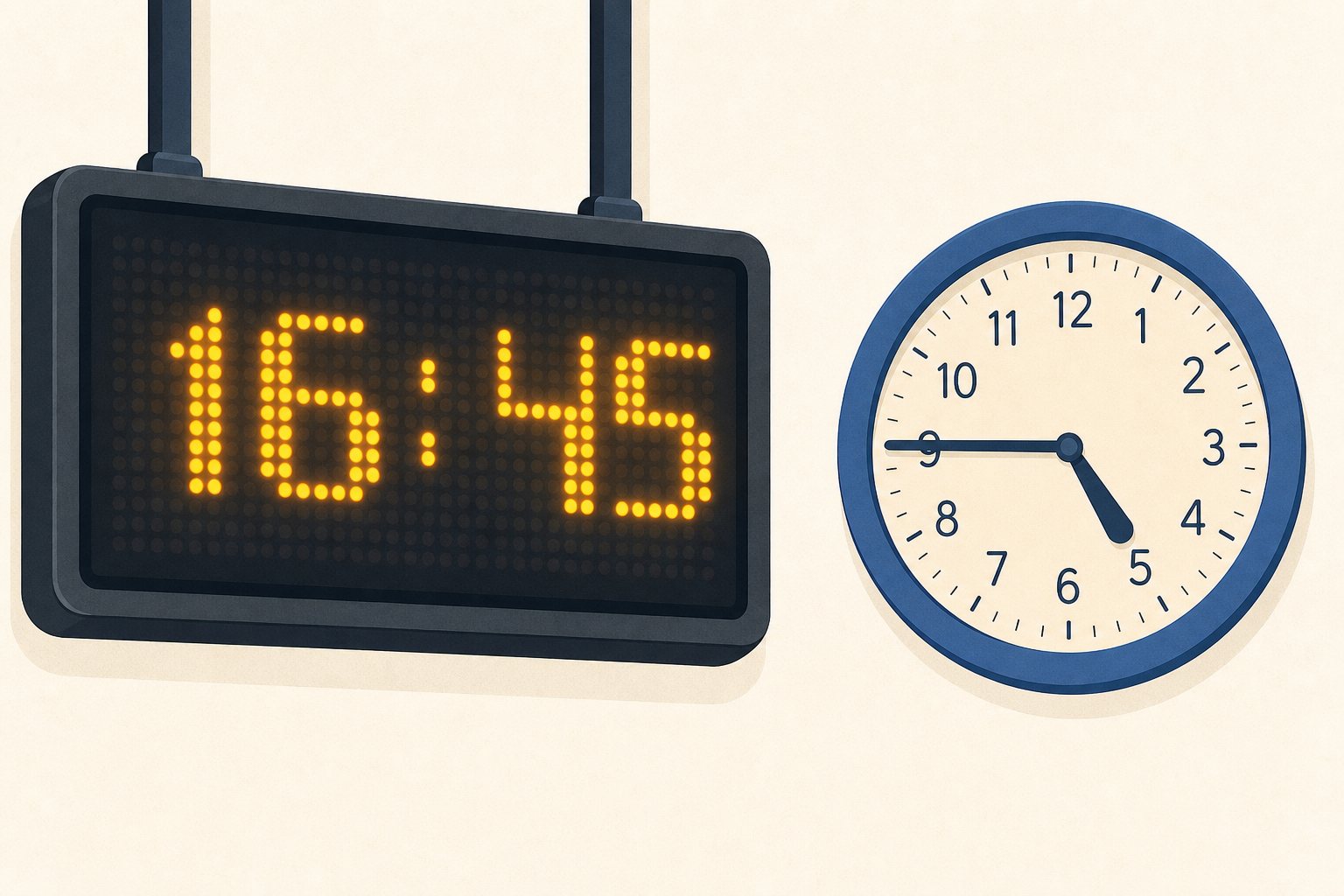
Look at the two clocks in the picture. One is a train-station departure board, the other is a kitchen clock, and the kitchen one is showing an afternoon time — it is after dinner, not before breakfast.
Are the two clocks showing the same time, or two different times? What makes you think so?
The clocks show the same times written two ways. Each clock face has a second ring of numbers inside the usual 1 to 12, running from 13 up to 24: that inner ring is the afternoon and evening hours. Watch how each morning and afternoon time turns into twenty-four-hour time, and keep an eye on that inner ring as it happens.
Today we work through these times together on the clock: 8:30 a.m., 3:45 p.m., 11:10 p.m. and 6:05 a.m. One pupil at a time sets each one on the board. Everyone else works out the 24-hour form in your head and we say it aloud together to check before the clock confirms it.
In your maths copy, draw a two-column table headed 12-hour and 24-hour. Write each of these times in both forms, one row under the other:
Then underline every row where you had to add twelve.
First we learn how to go backwards from 24-hour time. Take the station board time 16:45: the hour is bigger than twelve, so subtract twelve from sixteen to get four, the minutes stay 45, and it is afternoon, so that is 4:45 p.m. Morning times under twelve just drop the leading zero and stay a.m.
Now we convert these five times. The first four are already shown in 24-hour form, so for each one say what it is in 12-hour form: 08:05, 14:30, 23:59 and 00:15. The last one goes the other way: 'twenty to midnight', say what that is in 24-hour form. The midnight and midday ones catch people out, so we will say each one aloud before we check it.
Why do airports and railways use the 24-hour clock instead of a.m. and p.m.? What problem could it cause if a train timetable just said '5:00'?
Next we use these time skills to work out elapsed time — how long something lasts when it runs across hours and even across midnight.
You're previewing this lesson. Get full access to this lesson and hundreds more — each one ready to teach, with interactive activities, printable resources and pupil progress tracking built in.